
On the Banks
Hurling, Invisible People & Moby Dick

1(Rory Gallagher ‘A Million Miles Away’)
Chapter 1. FROM THE SOURCE
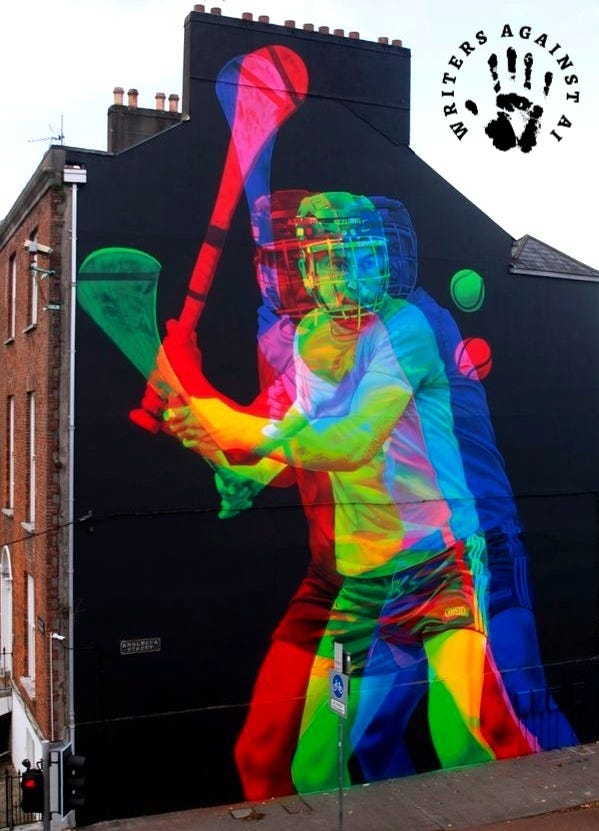
Not so long ago I walked across the Irish city of Cork while the men’s Senior All-Ireland hurling final, in which the Cork team were playing, was on. On my way the empty city streets were punctuated by choruses of delight or groans floating through the humid air - it seemed that almost the entire city was glued to their TV screens.
I caught the second half of the match when I reached my destination: Cork lost to Tipperary by a whopping fifteen points. The match was played over a hundred miles north in Dublin’s Croke Park stadium by the side of the River Liffey, but for a short spell that afternoon, it seemed that almost the whole of Cork city rode the waves of exhilaration or despair rolling through the thundery air together.
The city of Cork is the second biggest (population roughly 225,000) and second oldest city in the Republic of Ireland: it dates back to the monastic foundation of St Finbar in the sixth century ACE. I have always thought Cork an unusually tribal place: all the Cork people I know (and I’m treading carefully here) believe that Cork is the best place to live in Ireland - if not the world.
Cork’s nickname is ‘The Rebel County’ - a name which comes, not as many believe from it being the site of some of the fiercest fighting during the Irish War of Independence against British rule in the 1920s, but instead the nickname dates as far back as 1491, the year before Christopher Columbus sailed for the Americas, to the county’s strong support for Perkin Warbeck, a Belgian pretender to the English throne.
Cork’s most famous son, Michael Collins - the man most responsible for the modern Irish nation-state in many eyes - was born in its hinterlands and he spent his last night on earth hard by the River Lee’s South Channel in the Imperial Hotel delivering from there his breezy prediction that:
Yerra, they will never shoot me in my own country2
But a few hours later Collins’ prediction proved tragically wrong when the quiet West Cork rural road at Béal na Bláth was splattered with his blood from a shot by a fellow Irish man - thus shattering the best chance for peace that the new Irish Free State had to stop the bitter Civil War which followed.3 4 5
Today Cork is the home of several US software and pharmaceutical giants: many thousands of locals work in Apple’s European headquarters on its Holly Hill campus overlooking the city’s northside and many thousands more work in the string of US pharmaceutical plants ringing Cork’s giant sea harbour on its southside.6
My Own Lovely Lee….7
Although hurling, one of the world’s oldest and fastest field sports, is now a key part of Cork identity and pride the sport’s local popularity dates only from the 1900s and the Gaelic Revival spearheaded by writers like Pádraig Pearse and William Butler Yeats. Before the All-Ireland final started the Cork team and fans belted out in unison the team song ‘On the banks of my own lovely Lee’: the anthemic musical tribute written by Dick Forbes in 1933 shortly before the renaissance of the city was marked by the reopening of Cork City Hall in 1936, to the river which splays across the city in silvery fingers on its way to one of the biggest natural sea harbours in the world - the ‘spreading Lee’ as the great Elizabethan poet Edmund Spenser wrote in 1590.8
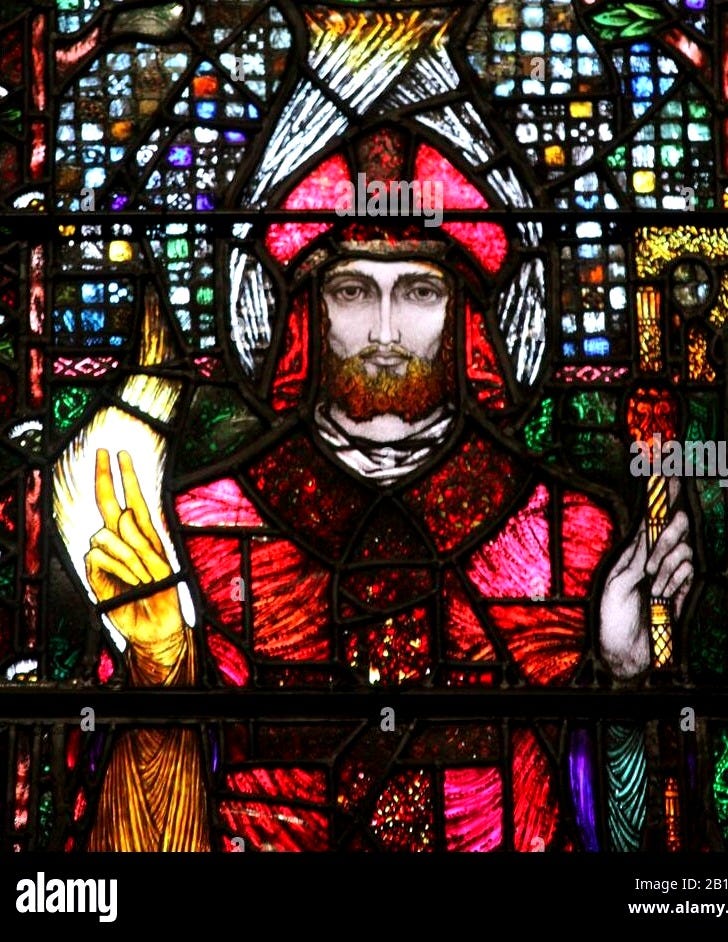
The origin story of Cork City comes from its patron saint Finbar - legend says that in the sixth century he was a monk who came to the headwaters of the River Lee at beauty spot of Gougan Barra. There he met the local river monster9 and raised his hand in prayer over it: the creature in its desperation to get away from him, thrashed out downstream the network of river tributaries beside which Finbar founded his monastery and around which the city grew in the centuries that followed.1011 (Finbar’s right hand, with which he blessed the monster, is supposed to have glowed with divine light afterwards, a charming detail picked out in Harry Clarke’s exquisite stained glass window in the Honan Chapel situated in the grounds of University College Cork, near the River Lee’s South Channel a stone’s throw from the original site of Finbar’s monastery).
The Powers and Principalities12

Monasteries like St Finbar’s sprouted across Europe in the Middle Ages and many became rich and powerful, owning huge swathes of land and running major industries such as milling and brewing. But these valuable assets could fall into the hands of corrupt clergy or greedy local nobles, so new legal safeguards were needed for them. Therefore in the twelfh century Pope Innocent IV invented the legal term of ‘Persona ficta’ : legal though fictious personhood, which enabled institutions like monasteries, universities and dioceses to act as single legal entities holding assets and being represented in court cases.
In later centuries the rights of ‘Persona ficta’ flowed to secular organisations like corporations (the name corporation itself coming from the Latin for body) so that today multi-nationals like the coffee giant Starbucks (named after the first mate on the whaling ship in the 1851 novel by Herman Melville Moby Dick) or the giant tech company Apple can hold assets, be represented in court and sue, or be sued, as if they were individual human beings.13
As well as corporations, Governments too act as a ‘Persona ficta’ - but unlike religious institutions or corporations these rights were originally vested in a real human being: the person of the monarch. One vestige of this for example is that every criminal case in the UK is pursued in the name of ‘Rex’ - in other words on behalf of the man occupying the throne: King Charles the Third (of course, given the physical impossibility of these powers being exercised by King Charles personally across every courtroom in the United Kingdom Rex is now an avatar of the British State). These powers, formerly vested in the monarch’s person and thence to the criminal barristers representing the British State, flowed to the new Irish nation-state on the declaration of the Irish Republic in 1949 - thus in the Irish criminal justice system state prosecutions are carried out in the name of a human being by virtue of their office - the Director of Public Prosecutions is the Irish state’s avatar and state equivalent of Rex.
Both corporations and governments are the main examples today of ‘non-human entities’ - who, have despite not being living human beings, nevertheless have at least the same rights in law as ones - but they are not its only instances. The concept of ‘ens legis14’/non human entity has recently been extended to rivers and eco-systems, for example in New Zealand the river Whanganui has been granted legal personhood enabling it to be represented in court prosecutions for pollution and other violations of its ‘personhood’ (there has even been discussions about the possibility of extending ‘ens legis’ to Large Language Models such as ChatGPT.15)
The Sleeping Spirit of Ireland16
Non-human entities (ens legis) like corporations and nation-states may be viewed simply as socially convenient fictions: collections of abstract rules and regulations which unite disparate groups of human beings into a common purpose. However one key difference between a corporation and a nation-state is that the latter tends to have a unifying national mythology - the shared history and set of commonly held symbols, stories and culture frequently invoked to summon ‘national spirit’. 17
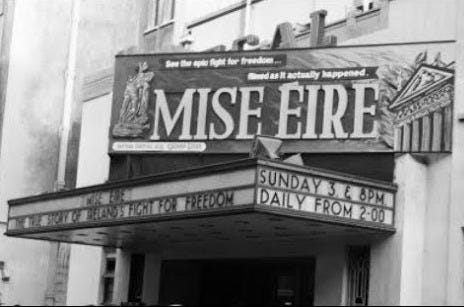
The creation of a ‘national spirit’ is normally a gradual and organic process spanning centuries but it also can be deliberately inflated by artistic or cultural means such as in the Irish Gaelic Revival of the 1900s. A later example of this is the 1959 landmark Irish language film ‘Mise Éire’ directed by George Morrisson, produced by Gaellinn with a soundtrack by the Cork composer Seán Ó Riada. This was, in my view, as culturally significant in its time as the 1998 Eurovision interval act of Riverdance (which I have written about here).
‘Mise Éire’ presented the origin story of the Irish Republic through a montage of rare photographs and film clips of key events such as the Easter Rising of 1916 and protagonists, including Cork’s own Michael Collins. Most of what is related in ‘Mise Éire’ are well known historical facts - but the film drew them together into a compelling piece of visual story telling powerfully underpinned by O’Riada’s wonderful music. This inserted characters like Pearse, Collins and events like the 1916 Easter Rising deep into Irish national consciousness thus bolstering the fledging Irish nation-state’s self confidence and pride. 18
The Faerie Queen19
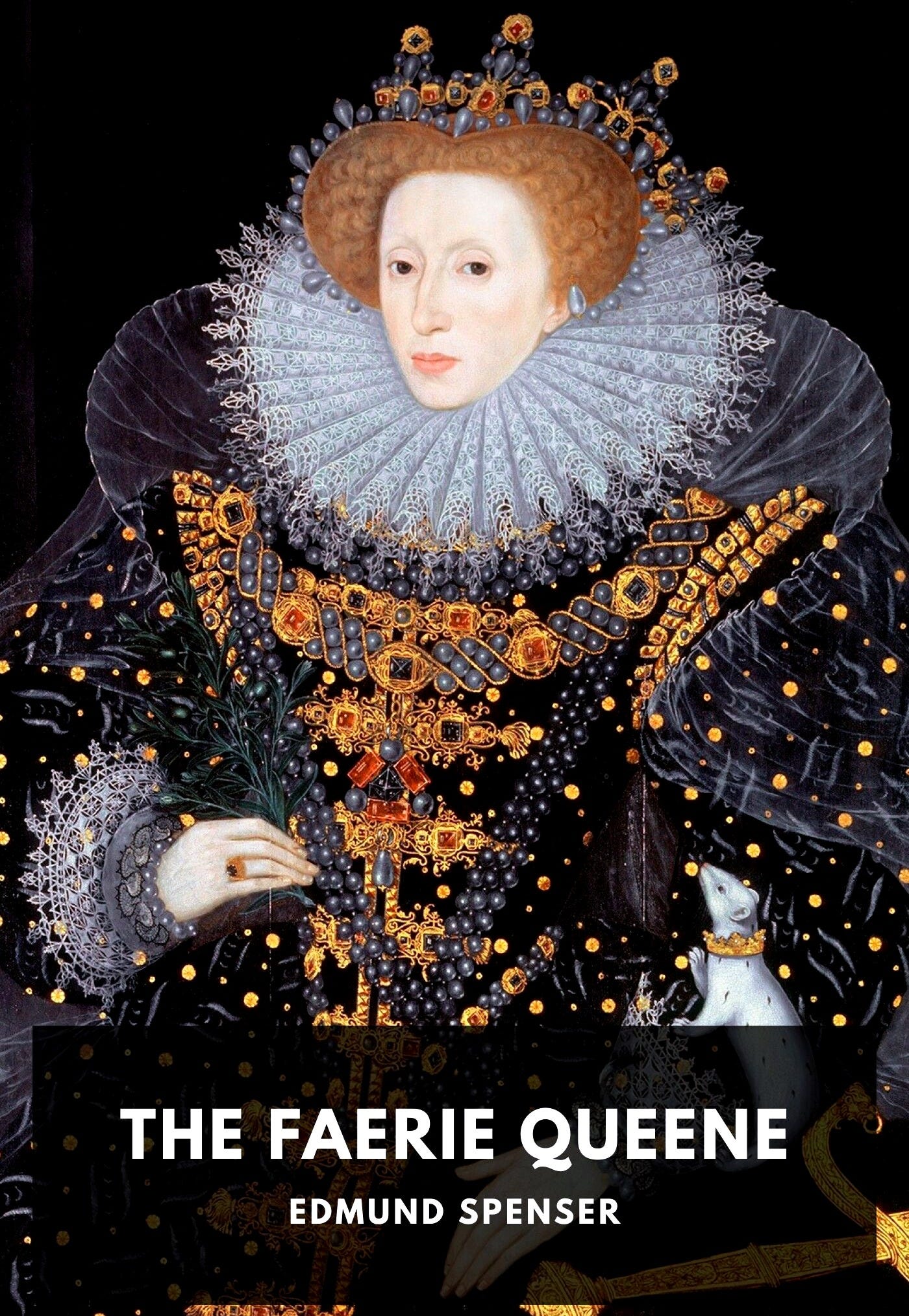
This was not the first time in Irish history that the arts were leveraged to support a national identity. In 1590 the English poet Edmund Spenser wrote his epic 36,000 line poem The Faerie Queen in Kilcolman Castle twenty miles north of Cork city on the lush green banks of the River Blackwater. Spenser dedicated The Faerie Queen to England’s Queen Elizabeth the First and it was, in part, a propaganda effort for the nascent Tudor state - casting the aging queen as the dazzling eponymous Faerie Queen, one of the earliest examples of what, in later centuries in Hollywood, would be called ‘star-making’; the deliberate and artificial cultivation of an aura of mystique around a human being. But Spenser’s The Faerie Queen is far more than just crude state propaganda - it is a magical tour de force with allegorical characters like the Knight of the RuddyCross (with his red-and-white tabard, the same colours as the Cork GAA team) fighting a dragon who representing arrogance and hubris.
The landscape of The Faerie Queen is set in the beautiful North Cork countryside of Spencer’s Kilcolman Castle on the banks of the River Blackwater:
I awoke and found her place devoid,
And naught but pressed grass where she had lain20
But this cherished place which inspired his luscious poetry, that he affectionately called ‘Hap hazard’ was not his ancestral home. Spenser was a newly arrived English government official who scooped up prime Munster land recently confiscated/stolen from its native Irish owners by the English Crown. He was one of a new breed called ‘planters’: partnering with the English State in proto public/private partnerships. The Crown’s buccolic name for the scheme ‘The Munster Plantation’ suggesting trees and countryside (in what maybe one of the first examples of what US professor Louise Mozingo calls ‘pastoral capitalism’ - countryside associated with moral virtue21) was a deliberately deceptive linguistic cloaking of the English State’s massive brutal and violent theft of Irish homes and land.22
Although entranced by the Irish countryside, Spenser felt nothing but contempt for the native Irish themselves a ‘disruptive and degraded people’. In his xenophobic 1596 pamphlet ‘A View of the Present State of Ireland: Discoursed by Way of a Dialogue between Eudoxus and Irenaeus’ he wrote some of the most racist diatribes ever penned against the ‘barbrous Irish’. In it he criticises Irish Brehon laws (too lenient), Irish childrearing (too soft) Irish clothes (too long), Irish hairstyles (ditto), and even Irish men’s habit of ‘immoderate wailings at funerals’ (unmanly and far too noisy in Spenser’s stiff upper lip opinion).23 In A View Spenser chillingly lays out the planters’ genocidal plans for subduing the Irish and stealing more of their land: first by violence and then by deliberately engineered mass starvation - and cold bloodly described the terrible results without a hint of pity:
Out of everye corner of the woode and glenns they came creepinge forth upon theire handes, for theire legges could not beare them; they looked Anatomies [of] death, they spake like ghostes, crying out of theire graves 24
The Smell of Tobacco in the Morning…25
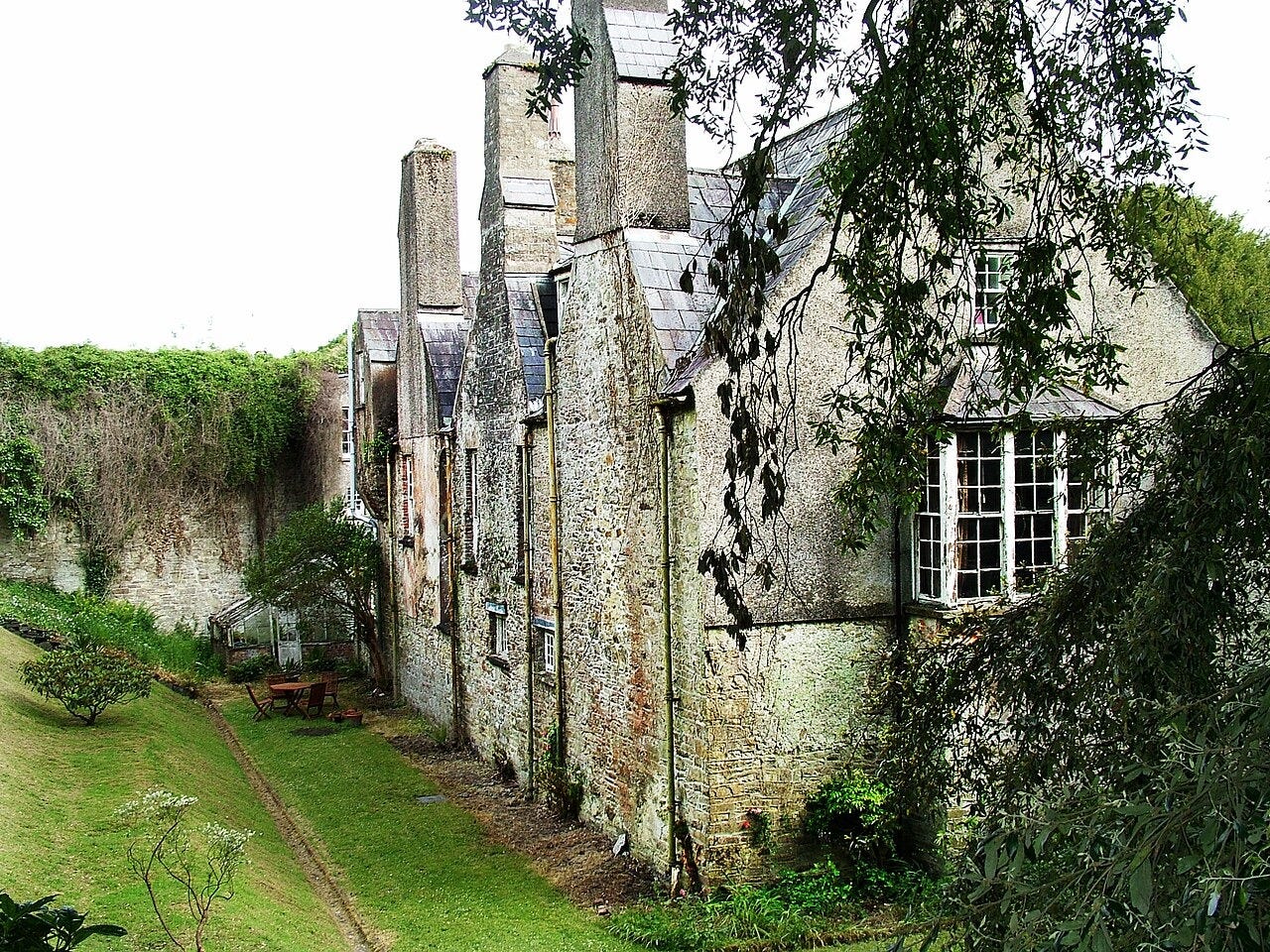
Downstream from Spenser in the pretty Cork town of Youghal at the mouth of the River Blackwater lived his equally famous friend Sir Walter Raleigh - when he wasn’t off on his trips to the Americas, allegedly bringing back from there both tobacco and potatoes (legend says that an Irish servant girl doused him in water thinking he was on fire while he was peacefully smoking tobacco in his Myrtle Grove garden).
Both men were key propagandists of the new ‘English Empire’ project in Ireland and the Americas with devastating impacts for both native populations. Raleigh, Elizabeth’s glamorous court favorite, showed a different and much darker side to his character when he moved to Ireland; in 1580 as a junior officer he took part in the depraved torture and mass beheadings of six hundred unarmed Spanish and Italian prisoners at Smerwick seventy six miles north of Cork, the stomach-turning details of were like a scene from a sixteenth century version of Francis Ford Coppola’s 1979 film ‘Apocalypse Now’ (and it is very probable that Spenser was there too). When the shocking details about Smerwick made their way to the Elizabethan court it cast an ugly stain on Raleigh’s reputation, but the queen herself shielded him from his critics.
In 1585, in a mark of her high favour, she granted Raleigh a royal charter to settle the first English colony in North America - and in return Raleigh dubbed the whole American continent ‘Virginia’ in her honor (a name that became closely associated with the tobacco industry)26. To fund the project Raleigh, ever short of money, partnered with London bankers and merchants creating one of the first ever joint-stock companies (a forerunner of a modern corporation) the Roanoke Company which recruited the colonists and paid for the colony’s guns, ships and supplies.
But soon, in an echo of what happened in Ireland, dark tales of the colonists’ brutality towards the American natives filtered back to the Elizabethan court damning Raleigh’s reputation there. Later English supply ships pulling up on its beach found Roanoke deserted with no sign of the colonists; they were presumed killed by vengeful American natives. Out-of-pocket London Roanoke investors were thus added to the already long list of Raleigh’s English enemies. After Elizabeth’s death in 1603 left him unshielded from them, Raleigh was imprisoned in the Tower of London and kept there until his execution in 1618 by James the First. His fertile Cork lands passed into the hands of Richard Boyle, the first Earl of Cork (and coincidentally the father of Robert Boyle, the famous scientist and discoverer of Boyle’s law and widely regarded as one of the founders of the science of chemistry from which the modern pharmaceutical industry springs).
Despite setbacks like Roanoke, the fledgling Elizabethan English Empire of the 1590s was the seed of the globe-spanning British Empire; but this was not foreseeable then. In the 1590s planter brutality finally galvanised the fissparious and squabbling tribal clans of Munster to rise up en-masse to expel Spenser and his fellow planters in the Nine Years’ War: Elizabethan England’s Vietnam27. In 1598 Kilcolman Castle was burnt to the ground, Spenser’s infant son died in the flames and the poet and his family fled back to England where he died the following year, broken-hearted and in poverty at the age of only forty-six. He was honored in death by a grateful English State by being buried next to the writer Geoffrey Chaucer in Westminster Abbey (and thus started the tradition of burying literary luminaries like William Wordsworth and Percy Shelley near each other in the part of the Abbey called Poet’s Corner) and his gravestone inscription there eulogises him as ‘The Prince of Poets’.28
As well being the origin of the British Empire, the English Munster Plantation project of late sixteenth century Ireland also produced in response to the brutality of men like Raleigh and Spencer a countervailing and oppositional identity of ‘Irishness’. This is not a unique response to colonisation: in his seminal 1961 book on the French/Algerian conflict ‘The Wretched of the Earth’ the writer Frantz Fanon points out that the French occupation of Algeria had the effect of coalescing a distinctive, but previously non-existent, Algerian identity. Cultural resistance is a key element of this and in the seventeenth century, the native Irish poets/filí poets in response to the Tudor propagandising myth making of Spenser’s Faerie Queen created their own mythopoetic genre: the ‘aisling’ poetry depicting Ireland as a vulnerable woman in need of protection. The downstream effects of this in the centuries that followed produced the Gaelic Revival of the 1900s and thus laid the groundwork for the eventual emergence of the Irish nation-state.
Leviathan: Non est potestas
The concept of the modern nation-state was in its infancy in the 1590s when even the most recognisable today like Italy or Germany were still scattered collections of city-polities. But between 1618 and 1648 the catastrophic Thirty Years’ wreaked devastation across Central Europe causing many millions of deaths through war, famine or disease. This was finally brought to an end by the 1648 Peace of Westphalia signed in the German city of Münster. In it new nation-states like the Swiss confederation and the newly independent Dutch Republic were recognised and this paved the way in later centuries for the emergence of giant, but previously non-existent, nation-states, like Italy, Poland and Germany.
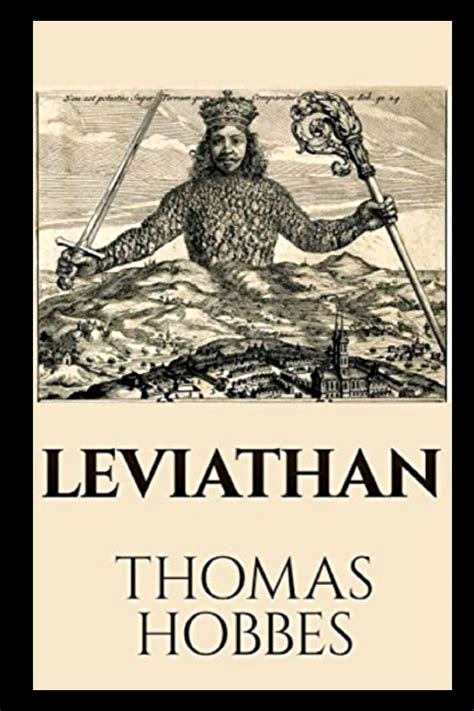
The social contract of many of these nascent nation-states was set out by the English writer Thomas Hobbes in his 1651 book ‘The Leviathan: or The Matter, Forme and Power of a Commonwealth Ecclesiasticall and Civil ’ written in the aftermath of the English Civil War - the overspill of which was the Cromwellian invasion of Ireland in 1649. In Leviathan Hobbes describes the relationship between the state and the citizen as akin to that between a protective parent and dependent child (you wonder how well this went down in Ireland where the Cromwellian state had been responsible for the deaths of an estimated fifth of the population).
Hobbes’ took his metaphor from the Hebrew Bible, in the Old Testament Jonah is swallowed by the giant whale Leviathan and the book’s subtitle was taken from the Biblical quote ‘Non est potestas Super Terram quae Comparetur ei’ (there is no power on earth compared to him). The original 1651 frontispiece engraving of Leviathan by the Parisian artist Abraham Bosse instructed by Hobbes depicted a giant crowned scaly man looming over the landscape wielding in either hand a sword and crozier - the symbols of sovereignty - to indicate the state’s influence over both the bodies and souls of its subjects (on closer examination the scales of the giant are revealed to be made up of hundreds of small people all gazing at his face).
Despite the paternalistic benvolence projected by Hobbes in Leviathan, few modern nation-states escaped painful and difficult birth pangs: most - like Italy in the nineteenth century - rose from the ashes of civil war and twentieth century modern Ireland was no exception. Michael Collins’ tragic death in 1922 was only one of the first which convulsed the new Irish state and pitted brother against brother in the Irish Civil War of 1922-23 - some of the bitterest fighting occurred in the areas around Counties Cork and Kerry and which is still remembered in local folk songs like ‘The Ohermong Ambush’.29
The Hag of Beara
The Irish Civil War was a bitter internecine war fought, not over money or land, but instead on whose ideals would be the pilot-light of the new nation-state. The choice between the sides was between the pro-Treaty pragmatists (led by Collins) or those wedded to the original republican ideals of 1916: the anti-Treatyites and it left its scars on Irish society for generations. 30
The Anti-Treatyites of the Irish Civil War saw themselves as the authentic inheritors of the legacy of Pádraig Pearse, writer of the original Mise Éire 1912 poem and later 1916 leader. This poem (after which the 1959 film was called) invoked the pre-Christian past of the island in its opening line:
Mise Éire:
Sine mé ná an Chailleach Bhéarra
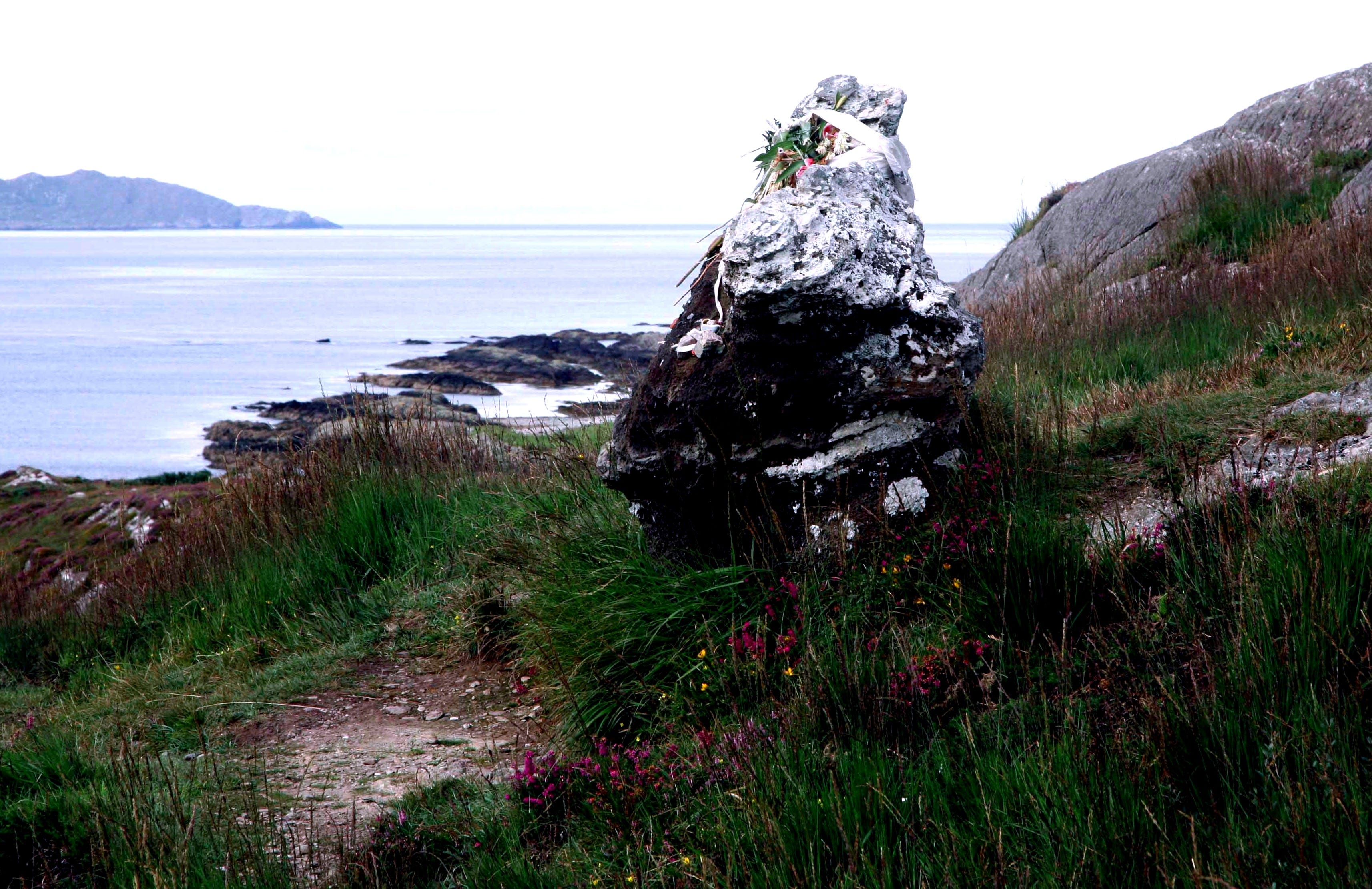
which translates to: ‘I am Ireland, the Hag of Beara’. The Hag of Beara is an ancient Celtic goddess representing the union between the land and sea: in local legend the goddess is represented by a rock formation on West Cork’s Beara pennisula facing into the full force of the Atlantic Ocean .
The Walk of A Queen…
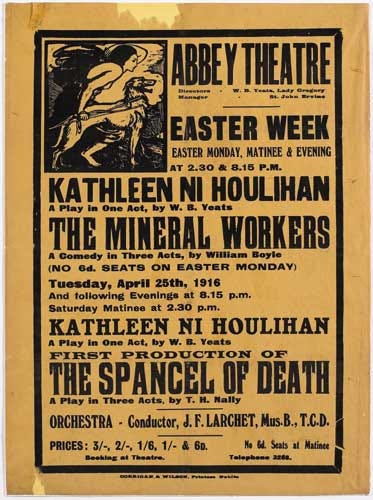
In April 1900 the aging Queen Victoria visited Dublin to a series of carefully choreographed displays of patriotic support by locals (amongst which was a visit to Blackrock College where one of the flagwaving schoolboys was an Edward de Valera a future President of Ireland). To counter the pro-monarchist sentiment whipped up by her visit the poet W.B. Yeats and his mentor Lady Gregory wrote the one act play Kathleen Ni Houlihan: the plot of this is that on the eve of their wedding an old woman visits a young couple and appeals to the bridegroom to fight those who have stolen her land the ‘four green fields’. The old woman/hag/Kathleen ni Houlihan character symbolises Ireland and she is revitalised by the willingness of the young bridegroom to leave his bride behind and fight for her freedom instead - by the play’s end she has been transformed:
I saw a young girl and she had the walk of a queen31
(The eponymous part of Kathleen Ni Houlihan was originally played by Yeat’s muse (and romantic infatuation) the middle class English schoolgirl-turned-revolutionary Maud Gonne).
In Kathleen Ni Houlihan Yeats succeeded beyond his wildest dreams to stoke his audience’s nascent patriotic sensibilities (his 1938 poem asks: ‘Did that play of mine send out, certain men the English shot? hints at his astonishment at what he had unleashed). The play ran for many years in Dublin’s Abbey Theatre but its Easter Monday 1916 performance had to be cancelled because many of its cast, and audience were taking part in the doomed 1916 Easter Rebellion (the answer to Yeats’ question in The Man and His Echo was undoubtedly ‘yes’, for example the actor Seán Connolly was shot dead while leading an attack on Dublin Castle in 1916). In the meantime Edward-now-Éamon de Valera had turned from a rugby-playing loyal alumni of Blackrock to fight alongside Pádraig Pearse and Michael Collins in the Easter Rising. He was sentenced to death and escaped the firing squad only by virtue of his US citizenship (and Collins escaped the same fate probably by pure luck).
Chapter 2. INVISIBLE GIANTS
A Complete Aisling32
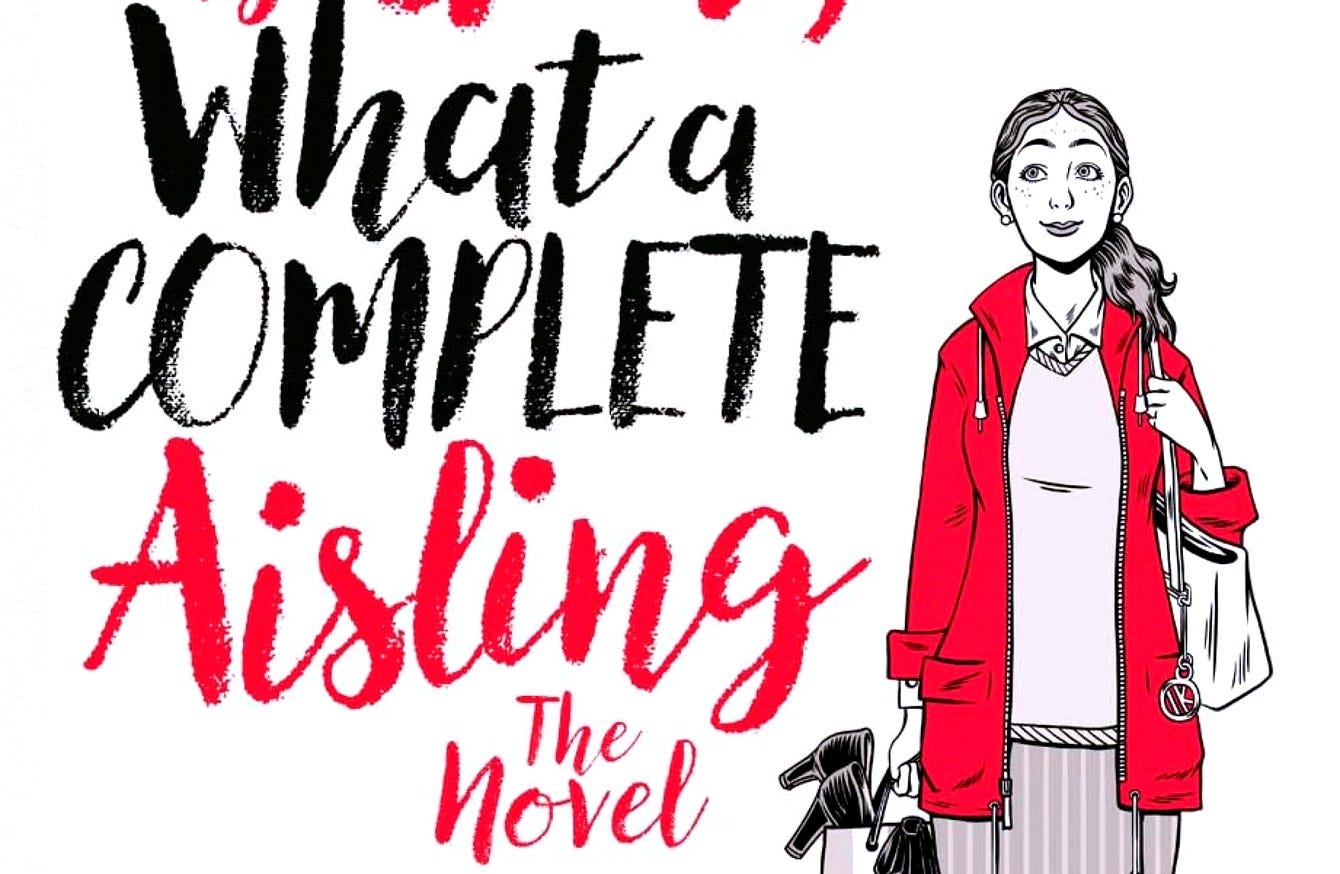
If Pearse and Yeats successfully invoked the spirit of Éire/Ireland in the 1900s as an oppressed old woman/hag in need of rescue, in today’s Ireland she might be more likely to be an ‘Aisling’ - a popular name for Irish girls (the name means ‘dream’), the eponymous sweet country-turned-city girl of the recent popular novels by Emer McLysaght and Sarah Breene.33 34
Today’s Aisling/Ireland may happily chat away on her smartphone (bye,bye,bye, bye) but increasingly the language used by her avatars, Irish politicians and civil servants, is a millon miles away from the poetic language of Pearse and Yeats. It borrows instead from corporate speech; Irish ministers and civil servants often talking of ‘taxpayer value’ and ‘stakeholders’rather than citizens. For example here is an extract from a 2025 speech by the Taoiseach (Irish Prime Minister) Cork-born Micheál Martin in which he sounds like a company CEO:
In the coming years we must make continued and accelerated progress in delivery, across areas such as housing, infrastructure, healthcare, energy, water, innovation, and addressing climate change – while also investing in our people and the services they need.35
(this is of course not confined to Ireland, increasing in my view citizens of Western democracies are treated more like their customers paying for a basket of services like education and defence from the State and the boundaries between corporate and public bodies are becoming ever more blurred). But this casual adoption of corporate language by government bodies/representatives occludes a major difference between a citizen and a consumer/worker as although companies may seek to foster corporate loyalty by mission statements/corporate teambuilding and so on, there are limits to this, as no one (in my knowledge) has ever volunteered to pick up a gun and die out of love for a company unlike a nation.
The Invisible World36
Today both nation-state governments and corporations wield enormous power over vast swathes of the planet and its human and non-human populations. These modern ens legis/non-human entities as well as having all the rights of a human being also have key advantages over one. Firstly, they do not have the temporal constraints of individual humans - a corporation or a government is not limited to the length of a single human life. Secondly ens legis have legal protections, like limited liability or state immunity from prosecution not available to individual human beings. And finally of course, these ens legis/non-human entities are not sentient beings - they cannot be subject to corporal punishments such as imprisonment, torture or even death.37
Therefore this has, in my view, created a power imbalance tilted in the favour of these ens legis/non-human entities - many of whom like large corporations behave more like sociopaths - careless of the environmental and societal damage that they are wreaking - than responsible citizens. Individual States too have recently behaved in ways that would be described if observed in a human being as sociopathic. Recent efforts to bring rogue states like the State of Israel to justice in institutions like the International Criminal Court have lead to trials and verdicts granted in absentia with no one forced to face consequences, which in my view merely underlines the courts’ impotency.
Both of these types of non-human entities/ens legis are, of course, run by people. Individuals working in vast corporate enterprises may be in their private lives morally and ethically scrupulous - but they are often as employees compelled by the narrow logic of shareholder and profit maximisation or policy decisions to take decisions which result in poor environmental or societal outcomes. In many cases the individual’s moral compass may be subsumed by the corporate culture in which they work - they can be, like Jonah, swallowed up in the belly of the whale.
Water, Water, Everywhere But Not a Drop to Drink…3839
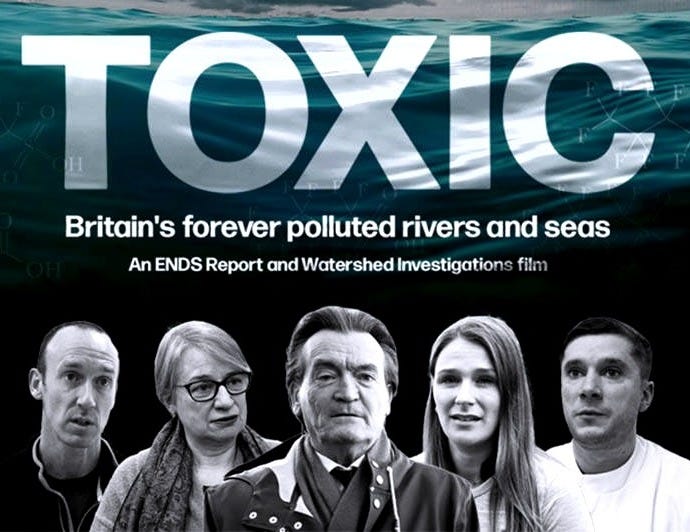
While there are many examples of destructive corporate culture, government organisations too may be guilty of pernicious work cultures where ‘value for the taxpayer’ is allowed to trump wider societal and environmental damage. Recent UK examples of this include the egregious failure by the Environment Agency to protect British rivers and coastlines from disastrous pollution by private water companies. In addition, on the English River Lea the agency itself (without any legal authority) abstracted huge volumes of river water causing mass fish and aquatic life kills. As the chairman of the Amwell Magna Fishery group (and Irish-born lead singer of the 1970s Derry rock group The Undertones) Fergal Sharkeley said:40
What is most extraordinary in all of this is that the very government agency established to protect, conserve and ensure our river’s futures is now engaged in decimating the oldest populations of breeding brown trout in the River Lea. An act of environmental vandalism unmatched in recent history.41
Sharkey’s comments form part of a widespread push-back by disillusioned consumers and citizens against abuses by the ens legis/non-human entities of giant global corporations and government bodies. But these are often ‘David and Goliath’ situations where individuals and small groups of concerned citizens face vast indifferent and legally powerful organisations. Against these overwheming odds people may be reduced to feelings of impotency or despair (this was memorably depicted in Franz Kafka’s 1914 novel ‘The Trial’ about the arbitary and unjust outcomes for the individual faced with the pitiless indifference and power imbalances of bureaucracy).
Help Me, Obi-Wan42
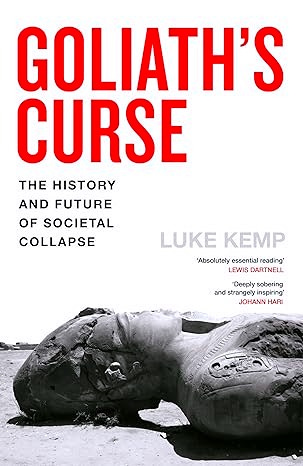
But, like the biblical Goliath, the apparent power and invincibility of these ens legis/non-human entities corporations and nation-states may mask underlying weakness: what Dr Luke Kemp recently dubbed ‘Goliath’s’ curse’. Dr Kemp is a senior academic from Cambridge University’s Centre for Existential Risk who has written a 2025 book called ‘Goliath’s Curse: The History and Future of Societal Collapse’ in which he sounds the alarm on our current global polycrisis. In Goliath’s Curse Dr Kemp traces the deep history of Empires worldwide and down the millenia from the Han Dynasty, to the Roman and more recently the British Empire and the present soi-disant American Empire43.
Dr Kemp’s contention is that throughout human history there is a tendency for societies to succumb to ‘Goliath’s Curse’ in the presence of a toxic set of ingredients. These are: the ready availability of cheap energy sources, like grain, or fossil fuels (what he calls Goliath’s fuel); the blocking off of easy escape routes for the remainder of the population (on what he calls caged land); or the sudden emergence of new weaponised technologies - for example the invention of guns (what he calls Goliath’s weapons). In his opinion when these things coincide there is a danger that power-hungry élites within a society use them to build organisational structures that funnel communal wealth to themselves with reckless disregard for the ensuing environmental or societal damage.
This is the power-dynamic pattern he labels ‘Empire’ which may be either proudly flaunted in language, architecture and visual iconography (like the Roman or British Empires) but in other settings might lurk like an unseen river monster beneath the facade of a seemingly democratic society (one hint of this might be in the 1961 farewell speech of US President Dwight D. Eisenhower warning about the dangers of over-reach by the ‘military-industrial complex’). In my opinion this power-dynamic pattern, whether explicitly labelled or not, is like a Magic-Eye picture: it is possible to see its sinuous and shape-shifting form hiding beneath many different settings, for example in the UK the near-monopoly of privately schooled and Oxbridge élites in areas as diverse as the arts, media, business and politics. I think this is a present day power dynamic closely resembling Dr Kemp’s ‘Empire’ description (but I could be wrong).
As Dr Kemp points out in Goliath’s Curse, local autonomy is often sacrified in these modern-day invisible Empires: indeed a key clue to their presence is their tendency to centralise power structures (famously ‘all roads lead to Rome’). In the present day several commentators have observed that the UK economy is dangerously tilted to London and the South East of England44 and Cork born politician and current Minister of State Michael Moynihan recently suggested that the same imbalance exists in the Irish Republic where Dublin is similarly privileged.45
Dr Kemp suggests that these invisible Empires veil their intentions to hijack communal resources by feeding their populations soothing or distracting propaganda ( ‘the glory of Rome’ or ‘the Empire on which the sun never sets, or today’s fear-mongering rolling news or celebrity gossip). But Dr Kemp contends that all of these Empires have within them the seeds of their own collapse as the insatiable demands of their élites end up causing widespread environmental and societial damage thus hollowing out their popular support. This results in the lower classes eventually either rebelling against, or walking away from these fatally corrupted societies.
He suggests paradoxically that in the wake of these collapses the lives of the majority of the population get better. Dr Kemp contends that there is persuasive evidence that the general health of European populations improved in the years following the fall of Western Roman Empire in the fifth century ACE. But as the history of the Roman Empire was written by the descendants (and later successors) of its élites then this is all scrubbed from the historical record. He traces this rise-and-fall Empire cycle repeatedly across human history and across the globe from the Han dynasty of China to the fall of the British Empire in more recent years.
The Matrix?
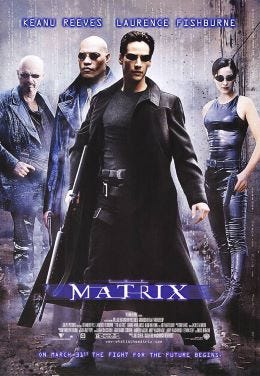
So where are today’s invisible Empires hiding? Dr Kemp suggests that they exist in the nexus of giant nation-states and global corporations. He suggests that these have now formed a vast matrix of interlocking globe-spanning power networks which have extended their slimy tentacles into every aspect of human and planetary life.
Dr Kemp, along with Professor Jem Bendell (whom I mentioned in my last essay here on money) suggests that time is fast running out on the latest version of Empire and that it is likely in the near future that some form of collapse will occur. If, as they both predict, this happens then it is likely to be a painful and difficult time for all of humanity - as, unlike the past, there is now little space on the planet left for survivors to retreat to.
Adults in the Room46
This may all sound like a tinfoil hat conspiracy theory and even to echo some right wing commentators on so-called ‘Deep State’ theories (or like the plot of the 1999 film sci-fi film The Matrix). But Dr Kemp (who is a senior academic) does not say in ‘Goliath’s curse‘ that he believes that present day global élites are acting in some kind of vast concerted global conspiracy to enslave the rest of humanity.47
My personal view is that like the silken strands of a spider web, the power-webs of these invisible Empires are hidden even from the élites entangled within them. The members of these may be blinded by their complacent convinction that what is best for them is best for the rest of us. It is easy to justify outsize accumulation of power and wealth if you truly believe that you are more educated/wiser/intelligent than everyone else. That you are one of, in the 2015 words of Christine Lagrande, the then head of the International Monetary Fund ‘the adults in the room’. She directed this remark to the Greek government’s representatives (which included its finance minister Yanis Varoufakis) in its debt bail-out negotiations with the EU.48 49In those negotiations the Greek delegation were forced, against the democratic wishes of their electorate, to accept a punitive bail-out package which inflicted huge and lasting damage on Greek society. Afterwards Varoufakis, who had been bitterly opposed to the humiliating deal, observed of Ms Lagrande and her colleagues:
Once caught in this web of power it takes an heroic disposition to turn whistle-blower, especially when one cannot hear oneself think amid the cacophony of so much money-making.50
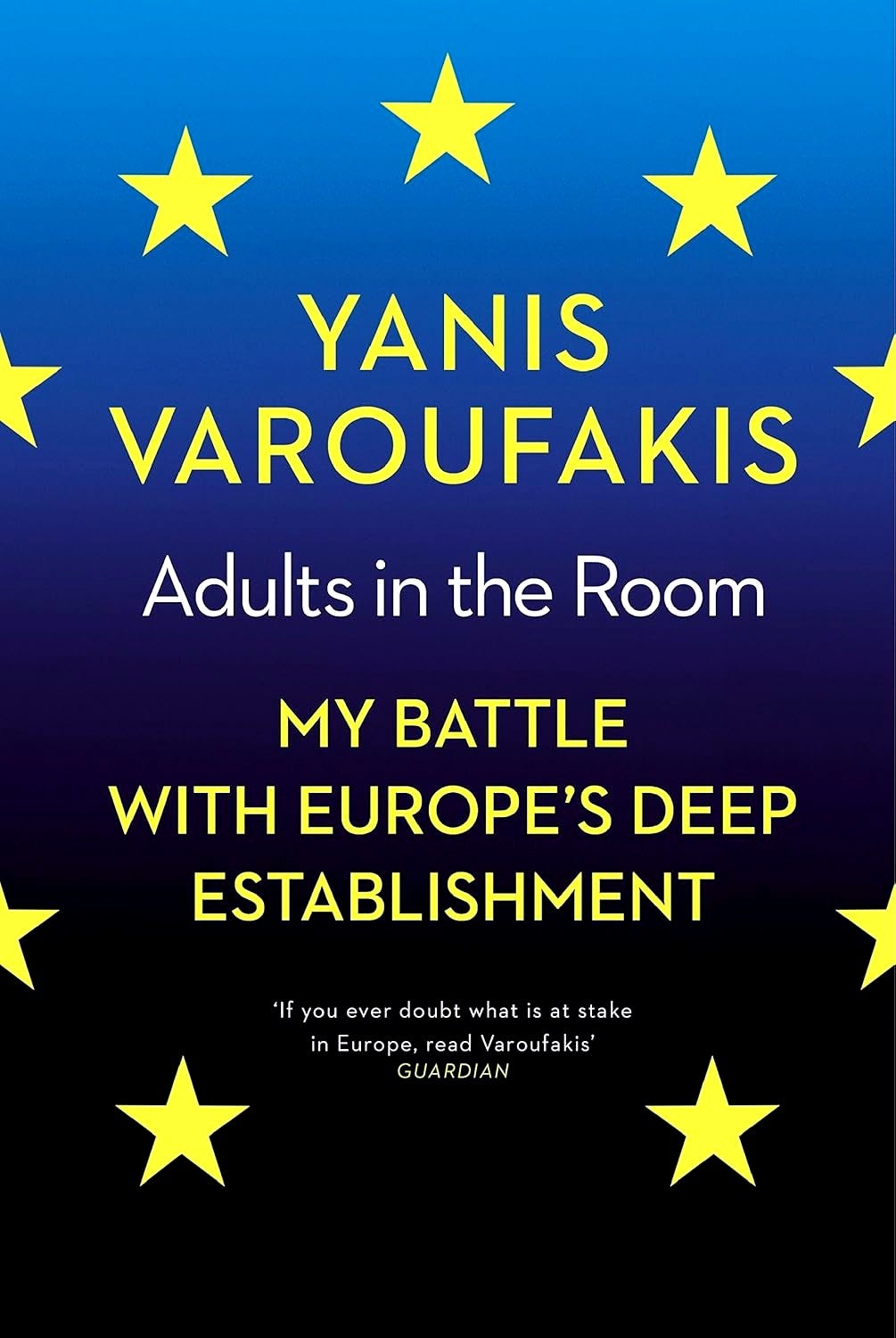
Varoufaki took Lagrande’s patronising remark as the title of his 2017 book ‘Adults in the Room: My Battle with Europe’s Deep Establishment’ - later made into a film in 2019. Although this might be seen as his revenge upon both Lagrande and her EU colleagues for his country’s humiliation, in his book Varoufaki takes more philosophical view recognising that she too was trapped in circumstances over which she and her confederates had little control.51
Beneath the specific events that I experienced, I recognised a universal story – the story of what happens when human beings find themselves at the mercy of cruel circumstances that have been generated by an inhuman, mostly unseen network of power relations. This is why there are no ‘goodies’ or ‘baddies’ in this book. Instead, it is populated by people doing their best, as they understand it, under conditions not of their choosing. Each of the persons I encountered and write about in these pages believed they were acting appropriately, but, taken together, their acts produced misfortune on a continental scale. Is this not the stuff of authentic tragedy?52
Chapter 3. WHALES & HURLEYS
Call me Ishmael53
The ‘authentic tragedy’ to which Varoufakis refers to is one often portrayed in literature. One of the most memorable examples of this is the 1851 novel Moby Dick by the US author Herman Melville about the doomed pursuit of the Great White Whale Moby Dick by the vengeful Captain Ahab on the whaling ship the Perquod. Melville drenched Moby Dick in Biblical symbolism, for instance in Chapter Nine of the book the Bible thumping sermon by Father Mapple hinges on the Old Testament story of Jonah and the giant whale.
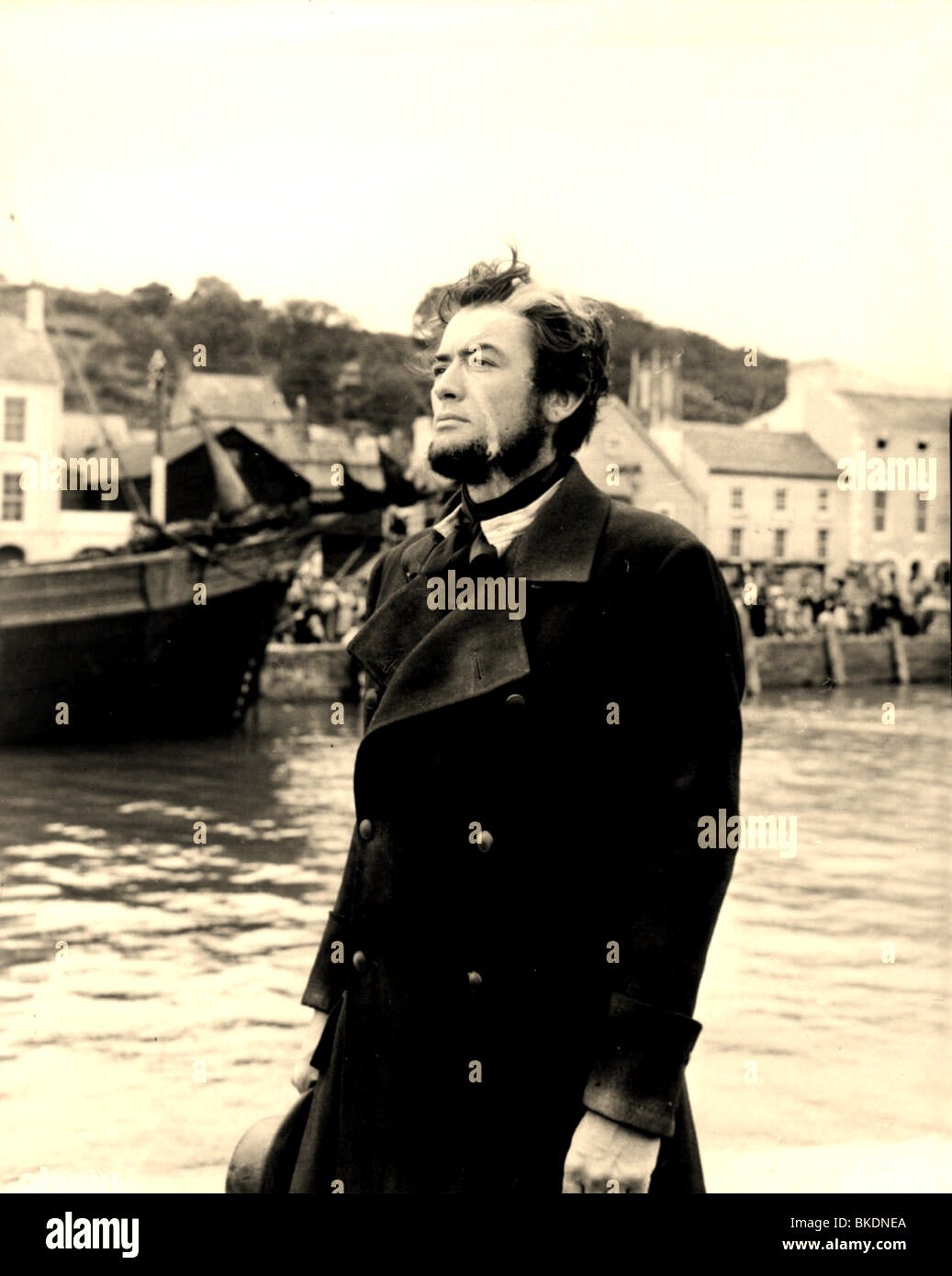
Some time ago I spoke to a man who in the 1950s had been the taxi driver for the famous US actor Gregory Peck ( ‘a lovely man’) whilst he was filming scenes from John Heuston’s award winning Warner Bros film in 1956 of Moby Dick in Youghal, the small Cork town previously famous for being the place where Oliver Cromwell finally sailed from Ireland after his short but destructive rampage in 1650 (and also of course the former home of Sir Walter Raleigh). Heuston’s Moby Dick is a powerful cinematic depiction of Melville’s masterpiece in which Peck channels Ahab’s murderous rage against the eponymous great White Whale Moby Dick (the role of Father Mapple was played by Orson Welles delivering a barnstorming cameo).54
Moby Dick tackles multiple themes like imperialism (the Perquod is named after an indigenous American Indian tribe); the moral corruption resulting from the mindless pursuit of wealth (Ahab nails a doubloon to the ship’s mast to bribe the crew to join in his doomed pursuit) and the dangers of unthinking compliance with orders. Heuston’s film nods to the insanity of the nuclear age - the pursuit of the whale leads the crew of Perquod to Bikini Atholl - the site of US 1950s nuclear bomb testing.
Ahab’s first mate Starbuck fails to stop him; although he knows full well that his captain’s mission is an insane and dangerous one:
Vengeance on a dumb brute!" cried Starbuck, "that simply smote thee from blindest instinct! Madness! To be enraged with a dumb thing, Captain Ahab, seems blasphemous."55
But Starbuck is the epitome of the loyal company man blindly following orders to his eventual death (and did no one from the coffee giant actually read Moby Dick before choosing the name?). Ahab too is a tragic figure - not knowing, or understanding that the natural forces he has pitched himself against are vast, impersonal, and wholly indifferent to him. As Starbuck points out, the giant whale neither knows nor cares about its puny human pursuers; the story of Moby Dick is thus a metaphor for impotency of the human condition, ranged against a pitiliess universe.
Moby Dick is an animal - a natural creature - but it is also unnatural, an albino whale. Perhaps Melville’s giant whale could be viewed as a metaphor for today’s ens legis/non-human entities like the nation-state or global corporations? Are these things which might have existed naturally, but are now grotesque excrescences of their original forms? And if so this is so, where can today’s Captain Ahabs be found? I think that, instead of on the deck of a whaling ship, they might be found gluing themselves to the road for ‘Just Stop Oil’, or being jailed as a member of Palestinian Action or writing on Substack about climate change -looks in the mirror56.
By the film’s end the only survivor of the Perquod is the narrator Ishmael, rescued from the sea by the whaling ship the Rachel. The Rachel is captained by Captain Gardiner; a man whose own son has been killed by Moby Dick, but whose shocked response to Ahab’s blasphemous diatribe against the behemoth is: ‘May God forgive you’.57 Ishmael in the Bible is the son of the slave Hagar and the patriarch Abraham who cast off both mother and son into the desert. Perhaps this is Melville’s hint that those best placed to survive the doomed projects of human Empires are its poor and outcasts? Ahab too is a Biblical name, a pagan King of Israel, the husband of Queen Jezebel. Melville may be suggesting in Moby Dick that the best response to Empires and the monsters that they throw up is not, like Ahab to sink into pointlessly rage against them, but, instead, like the Christians Captain Gardiner and St Finbar, to forgive them.
In Good Old Cork..58
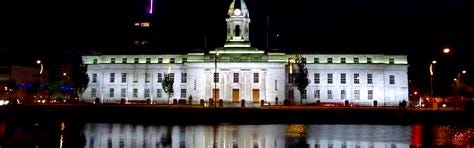
So what has any of this to do with Cork? Where might you find Dr Kemp’s Goliaths or Moby Dicks/ens legis/non-human entities there? One answer might be behind the gleaming white ashlar facades of Cork City Hall mirrored onto the River Lee where its two main river channels join. City Hall was built in the early 1930s as a replacement for the previous City Hall burned down by the British Army in 1920 during the Irish War of Independence: this was widely seen as revenge for the humiliation of British forces in a series of recent devastating ambushes by the famous West Cork Brigade lead by Tom Barry (after Irish independence, in a concilatory gesture, the British Government paid for City Hall’s reconstruction and it was opened on the 8th of September 1936 by the Taoiseach Éamon de Valera).
Despite rising from colonial ashes City Hall’s present occupants Cork City Council can on occasions, in my view, behave just as callously as its former British masters ever did; for example, it recently drew the following stinging rebuke from the Irish High Court judge stating that it had against an individual Irish citizen:
invoked a taxation process which it knew or ought to have known was unlawful. This continued for years, with the unlawfulness of the scale being conceded “the moment it was challenged in the High Court,” the court said. Further, the court held that the Council “actively invoked, exploited and endorsed an unlawful system of taxation of costs” and the solicitors acted “arrogantly” by drawing up the tendered costs.5960
Mac The Knife61
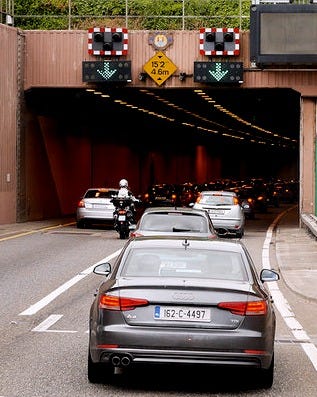
Another example of the ens legis/Empire power dynamic lurking in Cork might be in some of the giant US pharmaceutical plants strung across the south shores of Cork’s huge sea harbour. Daily thousands of commuters descent into the Jack Lynch Road Tunnel (named after a previous Cork All-Ireland hurling champion captain and Taoiseach) beneath the harbour on their way to work in the bowels of these factories. Some of these companies hold a knife to the city’s economic throat with a drumbeat of threats of workforce shrinkage or plant closures (thinly veiled threats from the Trump White House about the lost US tax revenues presently pouring into the Irish Exchequer ‘Ireland’s been very smart’ can’t help local anxieties ).
You Were in Our Hearts62
But, you might ask (a bit wearily probably) what are the alternatives to any of this? Isn’t it inevitable when any collection of human beings join together in a common purpose - whether that is government or private enterprise? Perhaps group consciousness always dips to its lowest common denominator: we may be nice people to our family and friends, but put us together in large groups governed by rigid abstract rules and either we become subsumed into vast mindless organisational whales like Moby Dick or else we are today’s Captain Ahabs on whaling longboats futilely hurling harpoons against them. Isn’t that Just The Way Things Are And What’s The Point of Complaining About It?
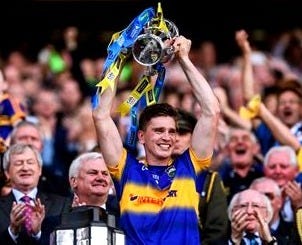
But perhaps that’s not true? On that balmy Cork afternoon I caught a glimpse of another possibility: I had not watched a hurling match in a very long time and had forgotten how graceful, but also how fast and dangerous it could be. Irish Senior county hurlers are all élite athetes but, despite this, amateurs (in very bad news for would-be Irish criminals, the winning Tipperary captain is a serving policeman).63But just because they are amateurs does not mean that they are anonymous. Cork’s Senior Men’s hurlers in particular enjoy near rock-star status (something I saw up close a few months earlier when I narrowly avoided being squashed by their giant cream coloured team bus as it barrelled down a narrow city street flanked by a phlanx of police motorcycle outriders heading towards the riverside stadium Páirc Uí Chaoimh).
When I set off on my rain drenched walk across Cork City in the first half of the match, Cork hurlers were totally dominating the match and under-dogs Tipperary were trailing them badly: I expected on my arrival to find them coasting to an easy victory. But while I was trudging across the silent city, the game’s fortunes dramatically shifted. When I arrived to find my friends watching the game’s second half the Tipperary team suddenly rose to playing brilliance that Cork utterly collapsed under. I watched in amazement as the Tipperary men repeatedly slammed the small rock-hard hurling ball (sliotar) into the back of the Cork goal net. By the end of the match Tipperary had won it by a comfortable margin: it was quite wonderful to watch (although not to the two disconsolate Cork fans that I was with).
What was equally wonderful was the moving heartfelt victory speech delivered by Tipperary’s captain Ronan Maher afterwards. It brought many of those watching (including me) to tears: he dedicated the team’s amazing victory to a young teammate Dillon Quirke who had tragically died of a heart attack aged only 24 during a previous game:
We carried your spirit with us every step of the way. You were in the dressing room, you were on the field of play. You were in our hearts, we hope we did you and your family proud today64.
From the winner’s podium he warmly congratulated his opponents on their sportmanship, the Cork players now sprawled in disappointment on the pitch beneath him, and finished by saying:
To our supporters, those who were lucky to be here today; those back home in Tipperary, our diaspora across the world. Today we stand at the summit after a long hard road, a journey of sacrifice and spirit.Wherever you are, you are never far from our hearts. This is a win for the people, for all of us. Enjoy the moment. Liam MacCarthy is coming home.65
I thought that this was, as well as a fine piece of oratory, but also an impressive demonstration that, if properly led, a group of people can become more than the sum of their individual contributions - that they could like the Tipperary team that day, face apparently insurmountable odds - and win.
Up The Rebels66
Despite Ronan Maher’s assertion that the All-Ireland final’s winner’s trophy (modelled on an ancient Irish communal drinking vessel a ‘mether’) joyfully hoisted by him that day was ‘coming home’ to Tipperary, most Cork people might question this as the Liam McCarthy Cup (named after a Cork emigrant) has been raised far more times in victory (over 30) by Cork hurling captains than most other Irish counties since the tournament began in 1888 (when Tipperary won it first, so okay, he might have had a point). This is somewhat surprising, as despite its moniker ‘The Rebel County’, Cork was for many centuries a stronghold of the British Empire: the city being one of its largest and busiest ports.
It hummed constantly with the trade of Empire - ships departed continuously from its river quays heavily loaded with grain and dairy drained from the surrounding Munster countryside and sugar, cotton and tobacco from the slave plantations of the Carribbean and the US poured into its riverside warehouses. People too flowed through Cork: thousands upon thousands of Irish streamed onto the emigrant boats anchored off its sea-harbour Queenstown (named in 1849 after Queen Victoria’s visit - this was at the height of the Great Famine: she is still scornfully known as ‘The Famine Queen’ ). Most were bound for the Americas including my own granduncle who boarded RMS Titanic from there in 1912.
Cork City was thus deeply intertwined with the British Empire’s vast net of money and exploitation for centuries (and it carries this legacy in streets named after long dead British aristocrats, Anglesea, Pembroke and others). But there is another thread to Cork history - one of the biggest mass starvation events in European history, the Great Irish Famine of 1845-1851 happened on its doorstep in places like the West Cork town of Skibbereen (producing the Irish rebel song ‘Revenge for Skibbereen’ in the decades that followed the Famine).67
Cork in Flames…
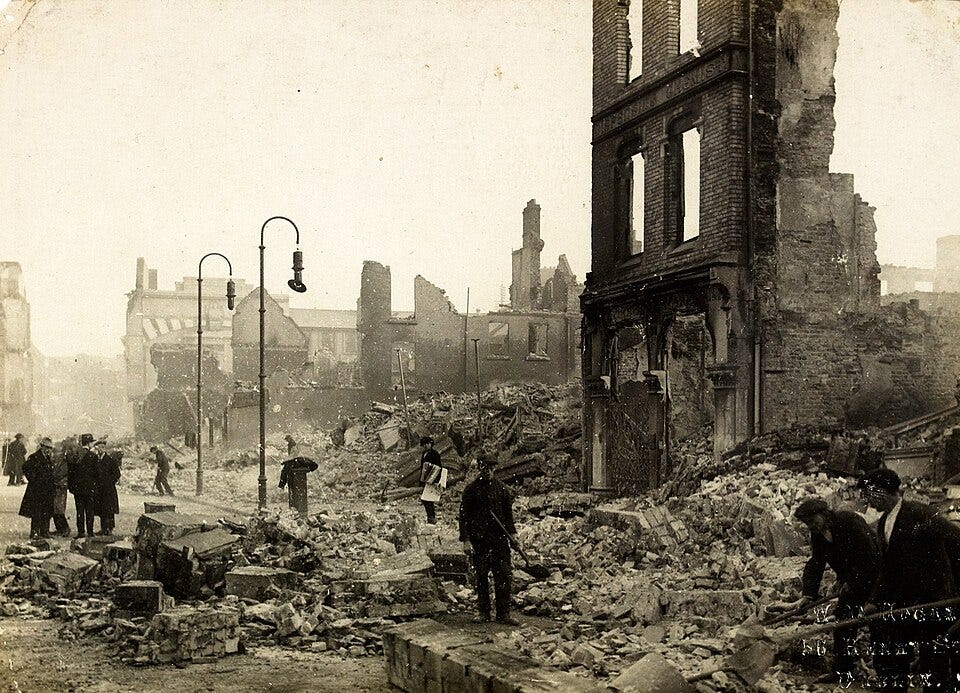
There is some evidence that the parts of Ireland hit hardest by the Irish Great Famine of 1847 were the ones in the generations that followed it where resistance to British rule became strongest - places like the West Cork birthplace of Michael Collins. During the Irish War of Independence between 1919 and 1922 Cork played an outsized role - and price. For, like the death throes of St Finbar’s river monster, the last days of the British Empire in Cork were destructive.
In 1920 the Empire’s vice-like grip on Cork suddenly became vulnerable; that year the British Army and the RIC suffered a number of humilitating defeats from local IRA groups like the West Cork Brigade. Even former middle-class stalwarts in the business community began to turn against it, in 1920 the town council of Queenstown defiantly renamed the town Cobh. In retaliation and frustration the British army spitefully set fire to five acres of Cork city centre (including City Hall) on the night of the 11th-12th of December and stopped the local firefighters from putting out the fires. A few days the Chief Secretary for Ireland Sir Hamar Greenwood brazenly lied to the British House of Commons that the fires had been set by local people (he blamed ‘the Sinn Féiners’) but the soldiers themselves swaggered around the city’s smouldering ruins with burnt corks in their berets blithely advertising their guilt.686970
Despite Sir Hamar’s assertion in February 1921 that the success of the Irish independence movement would mean the ‘break-up of the Empire and our civilisation’ later that year he faced Cork’s own Michael Collins in London across the table in the 1922 Anglo-Irish Treaty negotiations. The treaty was signed in London on the 6th of December 1921 and it brought the conflict to an end to widespread relief.71
Raising the Flag…
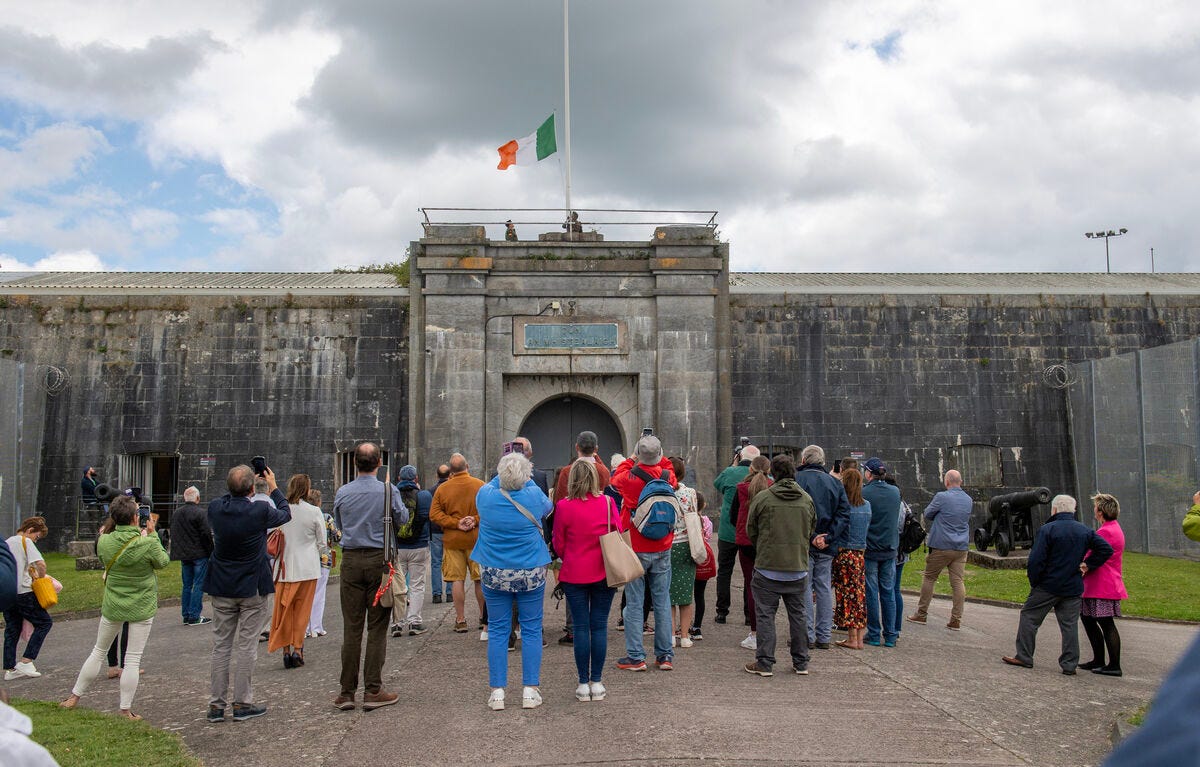
Under the terms of the Treaty British soldiers left Cork in 1922, but their sailors remained in Cork’s naval base at Spike Island across the harbour from Cobh (from which they saluted Collins’ coffin on the SS Classic on the 28th of August 1922 as it sailed past en-route to his state funeral in Dublin while the carillion of bells from Cobh Cathedral tolled mournfully across the water).
Spike Island, and its sister port Berehaven on the Beara pennisula, were two of the three Irish ports retained by the Royal Navy in Southern Ireland called Treaty Ports just before the outbreak of the Second World War, the Taoiseach Éamon de Valera negotiated their return to the Irish State (to the chagrin of Winston Churchill who called it ‘folly’). Éamon De Valera himself personally hoisted the Irish tricolour up the flagpole on Spike Island on the 11th of July 1938 as the last Royal Navy sailors on the H.M.S. Acasta steamed out onto the open sea72 to the sound of the cheers of forty thousand people lining the harbour the last tentacles of the British Empire withdrew from Cork shores (in a sad footnote less than two years after she left Cork, in 1940 H.M.S. Acasta sank off the Orkneys in a naval battle and 161 of her sailors drowned).
Let’s Blow This Thing and Go Home..

So in a thought experiment, what would happen if one of today’s invisible Empires left Cork? For instance what would happen if Google, Apple, or one of the US pharmaceutical giants buckled under President Trump’s threats and moved back to the US? Or even if, like the Deathstar in the 1977 Star Wars film, Cork City Hall exploded raining failed planning applications and parking tickets from the sky?
Could Cork survive?
Bury Me With My Hurley73
In other words what happens to a place when an Empire falls? Dr Kemp writes in Goliath’s Curse that after the fall of the Roman Empire many of its subjects found more communal lives rooted in their regional traditions and localities. He believes that the decline of the Roman Empire was a tragedy only for its élites (who wrote most of the historical narratives) but for the rest of humanity ruled by them it may have been a welcome relief from their exploitation and domination.
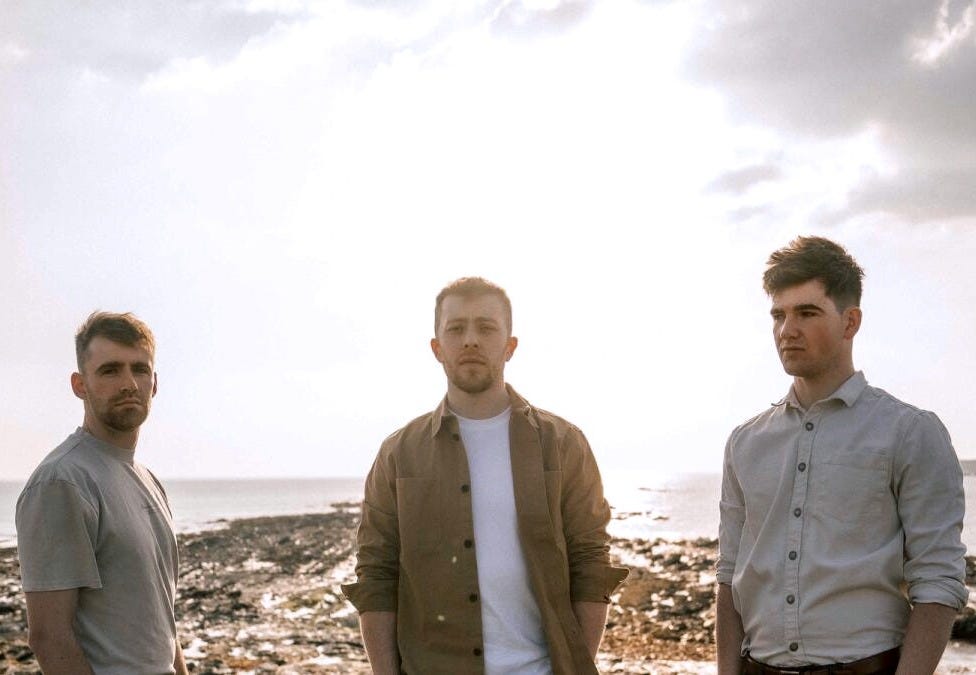
I am reminded of his view by the 2025 song Killeagh about a small East Cork village hurling team. Killeagh is steeped in love for hurling, family and the East Cork landscape where its young composer Eóin Fitzgibbon of the Irish folk group Kingfishr grew up. Like the winning speech from the Tipperary hurling captain Ronan Maher Killeagh is a powerful reminder that, in this corner of the world, love for family, tradition and locality have deep roots and that the next Irish generation know and value this.
In its origin myth Cork’s patron saint St Finbar vanquished the river monster at Gougan Barrie not with violence, but with a blessing. His new monastic city by the banks of the Lee was built on top of the destruction wrought by the monster’s death-throes. And in my humble opinion, even if all Cork’s present Empires leave, it will survive because it has kept going down centuries of invasion, war and famine since and risen from the ashes of Empire before.
It will carry on, I think, because Cork is the place where being a ‘gas man’ is not a job description but a compliment; the place where people sing emotional songs together and men cry in public over the death of a friend without shame.74 It is the place where, for the sheer joy of it, they play insanely dangerous ball games on wet pitches suffused with the dappled light that bounces off the water that threads through its vibrant green fields and laps at its shores.
The Romans believed that each place had its own deity, its genius locii or local spirit (might this be considered another form of non-human entity/ens legis?). If Cork does have a genius locii, I am sure, like a modern RuddyCross knight that it wears a red and white GAA jersey and I think it felt it pulsating through the thundery air that day of the All-Ireland final.
The Cork spirit, I believe, is a kinder and more intelligent one than any possessed by the mean-spirited giant corporations or government bodies squatting on its banks. It is, I think, the love of home carried in the hearts of every Cork man and woman, whereever in the world they may be. Cork is a true place, and as Melville says in Moby Dick:
it is not down in any map; true places never are75
Of course Cork people know all of this; they already think they live in the best place in the world - and (whisper it) they might just have a point.
But don’t tell them I said so….
If you have enjoyed this essay (and you want me to continue writing) then:
Press the Like button
If you have a Substack of your own please Restack this piece or a quote from it.
Comment (I love feedback)
Share with people you think might enjoy it. Thank you for reading.
https://www.irishcentral.com/roots/history/michael-collins-quotes
The tiny Irish place called poetically ‘The Mouth of the Flowers’
On the news of his death a thousand Anti Treaty prisoners - Collins’ bitterest opponents - spontaneously knelt and said the the Catholic prayer cycle, the Rosary, their voices echoing across the cells and corridors of Kilmainham Jail - the place that the British had imprisoned the 1916 leaders and Collins himself only a few short years before
The tragedy convulsed the new state, and it remains one of the biggest counterfactuals in Irish history - whether Collins could have prevented the vicious Irish-on-Irish blood letting that followed. My late grandfather often said grimly that what the British did to the Irish was nothing to what the Irish did to each other in the Civil War.
This is appropriate because since both the seventeenth century Richard Boyle, one of the founders of modern chemistry and the nineteenth century Charles Babbage, one of the founders of modern computer science, either came from or lived in Cork.
https://www.libraryireland.com/Wonders/Spensers-Irish-Rivers-7.php
https://en.wikipedia.org/wiki/Fomorians
an Irish nickname for ‘blondie’
coming from the Gaelic name meaning Great Marsh - the city is built on the Lee’s river delta
https://www.biblegateway.com/passage/?search=Ephesians%206%3A12-20&version=KJV;NIV
https://www.britannica.com/biography/Innocent-IV
https://legalclarity.org/what-is-ens-legis-and-how-does-it-differ-from-natural-persons/
https://pmc.ncbi.nlm.nih.gov/articles/PMC7256573/
Many corporations also foster a company culture, but this is usually ephemeral.
named after a poem by 1916 leader Padraig Pearse
The Faerie Queen, Canto IX, stanza 15, Edmund Spenser, 1590
https://mitpress.mit.edu/9780262526142/pastoral-capitalism/
https://www.libraryireland.com/HullHistory/Munster1.php
ibid.
ibid.
https://encyclopediavirginia.org/entries/elizabeth-i-1533-1603/
unlike the more determined effort at the Northern opposite end of the island some decades later in the reign of Elizabeth’s Scottish successor James - the aftermath of which is the present state of Northern Ireland
https://www.binneas.ie/the-ohermong-ambush-song
These ideals had been forged over the centuries in the resistance against the Elizabethan Munster plantations, the aftermath of the Cromwellian and the Williamite Wars and in the growth of new nationalism in the nineteenth century in the wake of the of the Great Famine of 1845-1851.
https://www.goodreads.com/quotes/583349-i-did-not-but-i-saw-a-young-girl-and
https://www.thejournal.ie/omgwaca-interview-3588617-Sep2017/
coincidentall also the name of the genre of medieval dream-poetry frequently used to invoke Ireland
https://www.gov.ie/en/department-of-the-taoiseach/speeches/speech-by-taoiseach-miche%C3%A1l-martin-at-the-national-economic-dialogue-2025-16-june-2025/ ( This is of course unfair since it was delivered at the National Economic Dialogue, not a party conference, but still you get the gist).
unless you count the instances of where a government is almost wholly dependent on a single leader for example as the Third Reich became on Adolf Hitler.
https://www.poetryfoundation.org/poems/43997/the-rime-of-the-ancient-mariner-text-of-1834
https://www.itv.com/news/anglia/2025-08-18/feargal-sharkey-accuses-environment-agency-of-unmatched-vandalism-of-river
This is an English river of the same name as the Cork one.
https://en.wikiquote.org/wiki/Karl_Rove is the source of the unnamed Bush presidential staffer infamous quote ‘We are an Empire now and when we act we create our own reality’
https://uclrethinkingeconomics.com/2025/06/23/the-death-of-the-town-the-uks-damaging-london-centricity/
https://www.irishexaminer.com/opinion/columnists/arid-41582398.html
but he does not not say it either.
https://www.keeptalkinggreece.com/2015/06/19/lagarde-greece-talks-need-adults-in-the-room/
This is not confined to the EU, one of British Prime Minister’s advisers recently talked about ‘This is about bringing the grown ups in’ - The Times, 2nd of September: Patrick McGuire: ‘New hires cannot fill the strategy vaccum at the heart of No 10’
Adults in the Room: My Battle with Europe's Deep Establishment, 2017,Yanis Varoufakis,Bodley Head Ltd.
ibid.
What also struck me was that the fans from opposing teams mingled in the stands of Croke Park, red and white Cork jerseys interspersed with blue and yellow Tipperary ones - there was no hint of animosity between the two sides and no need to separate them.
https://duckduckgo.com/?q=Orson+Welles+Father+Mapple&atb=v273-1&t=chromentp&ia=videos&iax=videos
Moby Dick, Herman Melville, 1851
Peck was only in his thirties when he played Ahab, a grizzled sea captain nearing the end of his life, and it wasn’t one of his best performances; he said in later life that he wished he had played it with more anger and bitterness: ‘ The film required more. At the time, I didn't have more in me’ perhaps the ‘more’ that Peck was referring to was the sadness of some of his later life experiences - he lost a son to suicide - the irreplaceable loss which might have fuelled the tragedy and anger of Ahab.
Moby Dick, Herman Melville, 1851
The excellent substack The Coordination of Power available here is an excellent explanation of how these conglomerations of unseen power relations congeal, trapping individuals entrained by culture, education and economic necessity into rigid organisational structures ).
I have to declare an interest here; I have seen the random and frequently inconsiderate parking of the city council officials on many occasions, while at the same time reading their public pablum about cycles lanes and allowing planning applications with very little parking on the grounds that the inhabitants will use public transport -so take this criticism with a grain of salt.
Another Irish example might be the international hedge, finance and pensions funds a hundred miles further north based in Dublin’s International Financial Centre - these companies are known in the finance industry as ‘whales’ due to their outsize influence on markets
https://financefuturists.com/what-is-a-whale-in-stocks/
https://www.tipperarylive.ie/video/pictures---videos/1543027/watch-emotional-singing-of-tipperary-anthem-slievenamon-on-the-steps-of-the-cathedral-in-thurles.html
The local GAA stadium in the city had set up TV screens to watch the match; on the side of it was the name of a supermarket, but underneath that was in larger letters, the name of a long dead GAA president in whose honor the stadium had been named: the locals had refused to allow his name to be removed. Money doesn’t always talk here.
https://www.tipperarylive.ie/news/all-ireland-final/1853804/tipperary-captain-ronan-maher-pays-emotional-tribute-to-the-late-dillon-quirke.html
ibid.
https://www.southernstar.ie/news/fr-mathew-recorded-the-worst-horrors-of-famine-in-west-cork-4094931
What also struck me was how comfortable this man was in his own skin, he had demonstrated through his impressive physical prowess on the pitch that he had nothing to prove to anyone
https://www.irishtimes.com/history/2023/03/02/great-famine-and-irish-independence-struggle-linked-by-geography-and-history/
https://www.creativecentenaries.org/on-this-day/sir-hamar-greenwood-on-the-future-government-of-ireland
though not before paying tribute to their former adversary Michael Collins https://www.ft.com/content/03d31cc8-73d4-4079-84c7-96dcf3780d1c
http://corkheritage.ie/?page_id=5697
This is one in the eye for Spenser and his seventeenth century version of ‘man up’, Irish men still cry.
Brilliant essay
Whew! This is an epic work and needs to be published in a Cork or Ireland-related publication. It is one of those identity-forming pieces that may serve as a David's stone against a Goliath.
You've woven these threads together into a beautiful tapestry that deserves more than two reads. Many themes intrigue me in all of this, but perhaps the most salient is the power of the non-human entity. What I believe you're identifying is that whatever we corporately worship (pay our attention to, hope in and consider "too big to fail") begins to carry a spiritual power of its own. It literally takes on a "life" of its own and destroys those who worship it. As you rightly point out, this is surely what the principalities and powers are. You've brought example after example here. It's fantastic food for thought!
Kemp's "Goliath's Curse" book sounds like a must-read. I suspect your hunch in response to it is correct:
"...perhaps this is a hint that those best placed to survive the doomed projects of human Empires are its poor and the outcasts." Perhaps this is why Jesus was found among them and points His followers to these groups.
Fantastic synthesis and lateral thought! Thank you.