
The Golden Calf
Irish Banking Crises, The Italian Job & Burning Money

1 (Jessie J’s, It’s All About the Money)
I’ll See You Right
Golden Dreams
Our Custom, And A Good One
Put-Your-Purse-Away
Chapter 1. I’ll See You Right
Is it possible to live in a modern Western country without money? Surely when people are unable to buy food, wages couldn’t be paid and businesses couldn’t take payments from their customers everything would grind to a halt?
Amazingly in the early 1970s that’s exactly what happened in Ireland during a series of banking crises which meant that for long periods of time there was no new cash issued, the banks were shut and there was no banking services (you can read about it here).
I was a child at the time but I spoke to several older people recently about how they managed to cope then - one of whom ran a business. They told me that in place of cash people used cheques: shops and pubs, in particular, operated on a system of mutual credit. You wrote a cheque or an IOU for your groceries or petrol and the shopkeeper trusted that these cheques or IOUs would eventually be honored. People went to work as usual and my parents who were bringing up a large family in rural Ireland got on with their daily lives although my mother conceded that it wasn’t always easy.
This was only possible because Ireland in the 1970s was a society with what’s called a ‘thick’ level of social knowledge, that is that everyone (and I mean everyone) in Ireland knew a lot about their neighbours: who to trust and who not to trust. This allowed businesses to make judgements on the social credit of their customers - who would honor their debts and were safe to advance credit to, and who were not. But this was not a one sided power dynamic: businesses who failed to advance credit to people for staples such as food or petrol risked a social backlash long after the crisis had abated (as I’ve written previously here the Irish are Olympic Champion grudge holders)
It was also possible for Irish society to continue to function despite the withdrawal of cash because in the 1970s Ireland there were lots of areas of life which operated entirely outside the monetary system, the so-called ‘gift’ economy. For instance most married woman didn’t go out to work and small children and the elderly were largely looked after at home. Additionally in the rural economy people often banded together for seasonal tasks like harvesting or turf cutting in what was known as a meitheal where labour was exchanged on a reciprocal basis.
We are the Self Preservation Society….2
In 2023 Professor Jem Bendell and an interdisciplinary team wrote a book called ‘Breaking Together: a freedom loving response to collapse’ about the various causes of the emerging crises that we find ourselves in now and the likelihood of environmental and societal collapse in the near future (and since it has been published there have been many more experts who echoed these concerns). In the second chapter Breaking Together called ‘Monetary Collapse’ he suggests that the planetary and climate crisis is inextricably linked to the global monetary system and its insatiable need for constant economic growth and he also suggests that this system itself is near the brink of collapse.
Bendell writes in this that in his opinion the real reasons driving our ever increasing thirst for fossil fuels and our decimation of the biosphere is that the whole global money system itself is in essentially a giant Ponzi scheme which requires constant growth to continue. He says:
I am saying that politicians have no choice but to try and grow GDP if they are to avoid their countries entering recession and facing economic ruin…I consider it a form of tyranny3
‘Breaking Together’ gives in my view gives an excellent account of why growth is so necessary to modern Western economies, and why we probably can’t escape the doom loop we are now in because of it. I can’t better his account so I recommend you go and read Chapter Two in it right now (hey, this blog might be free but I expect you to do some work too: I never said this was a beach read). You can find it here.
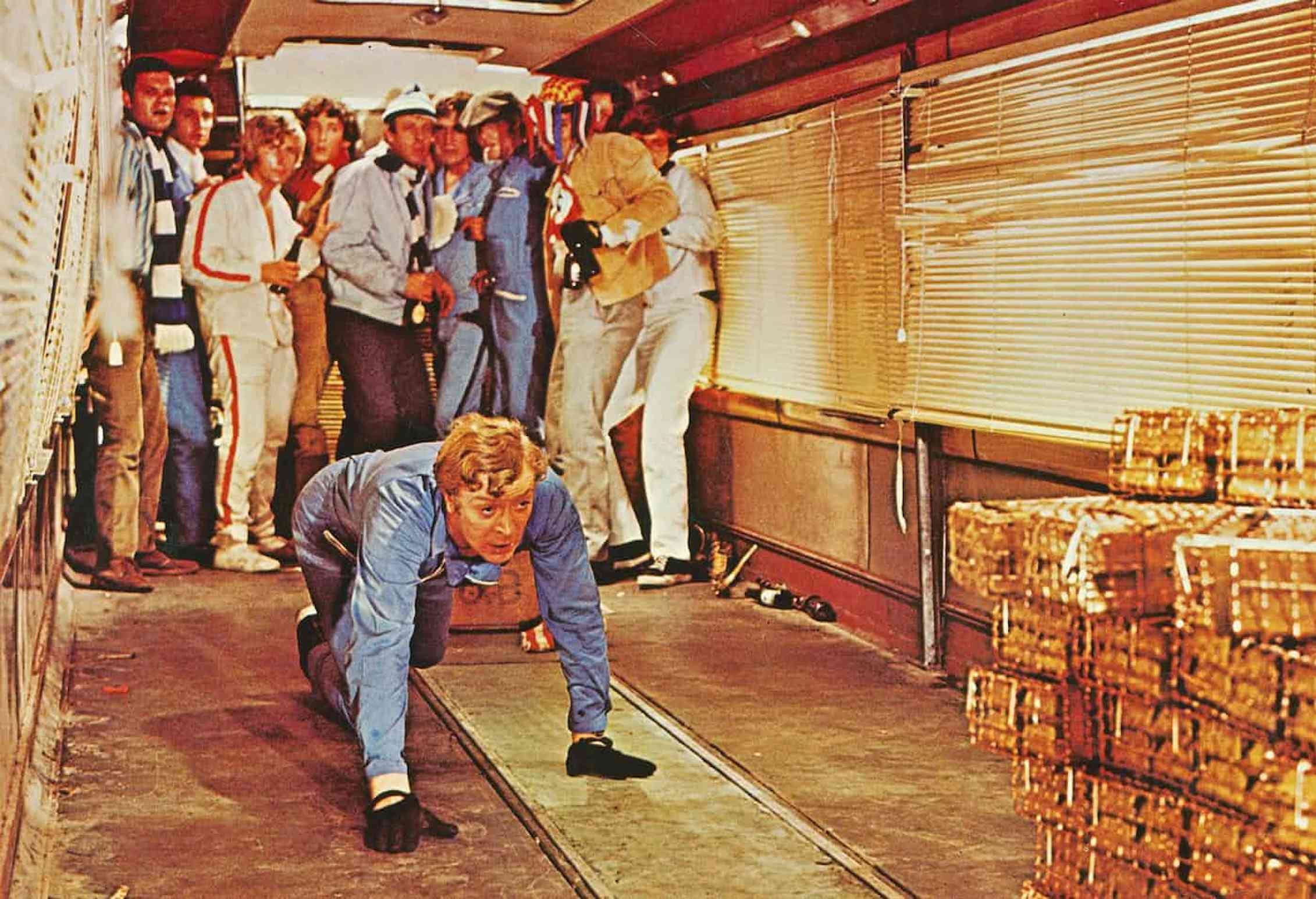
Since I like my cultural touchstones, this gives me the perfect excuse to talk about one of my favorite films, the classic 1969 British gangster caper ‘The Italian Job’ starring Michael Caine. The film famously ends with the bus seesawing over a Swiss ravine with the weight of gold pulling the bus down balanced against the gang bunched up at the other end of the bus. If you have read the chapter on the global monetary system in Breaking Together as I suggested you might recognise that this is an excellent metaphor for the situation that humanity presently finds itself it - dragged over the cliff by a money system that it has lost control over.
(All I can say in addition to what Breaking Together so cognently lays out is that if you want to know where the pernicious idea of perpetual economic growth came from, in my opinion it was principally caused by the invention of compound interest by Italian banking families in the early 1200s. In other words all this madness started as The Italian Job….(sorry, too good to resist)).
But Bendell description’s of the present money system in Breaking Together is miles away from what most people think of money and how it works ….
Chapter 2. Golden Dreams
Goldfinger…..4
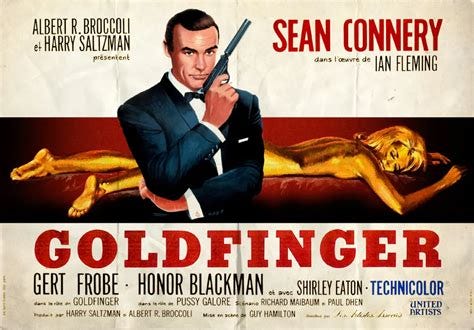
The public understanding of money might be encapsulated in the 1964 James Bond film ‘Goldfinger’. The film’s plot revolves around an attempt by the eponynomous villain on Fort Knox the home of the American Gold Treasury; not to steal its gold, but to irradiate it because then the entire world economy would collapse because gold equals money and destroying the gold would destroy the money supply. And this would hand him enormous power and enable him to blackmail the world into doing his bidding. Or something like that.
This view of money is as a kind of shadow of a real thing, the dollar for instance being the equivalent of a certain amount of gold. This is probably how how most of us think of money; that at some point if you or I really wanted to we could march to the Bank of England or the Federal Reserve today and demand chips off a bar of bullion in exchange for wads of paper or digits in our online bank accounts.
But as anyone with an ounce of knowledge about economics knows, the premise behind the film is complete rubbish now because if all the gold in Fort Knox were to be irradiated then it wouldn’t make a blind bit of difference; the government of the US hasn’t depended on the gold standard since the 1970s and neither has the UK or any other country. Currency today is instead what’s called a fiat currency, there is no precious metal equivalent which you could demand from the US Federal Reserve or the Bank of England for your wad of 10 or 20 dollar or pound notes.
A British Bank is run with precision….5
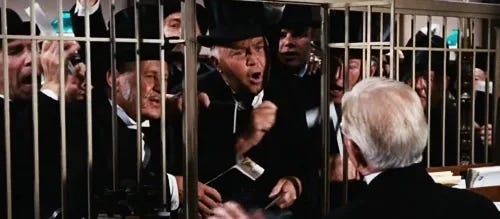
Instead a far better representation of money in popular culture might be from another film released in the same year as ‘Goldfinger’, that is the children’s film ‘Mary Poppins’. In one scene one of the Banks children accidentally causes a run on a bank by starting a rumour that it is unable to redeem a penny thus causing the bank to close its doors as hordes of panicked customers demand their money from it.
What this scene nicely explains is that money is more about belief that the bank would pay, than about the actual physical reality of coins, notes or gold bullion. This belief exists inside group human consciousness, if large numbers of people agree to accept that a bank note is an acceptable way to pay for something, then it works. But, as in the film, if this belief breaks down then the entire system collapses in a run on the bank.
Money in this view is a kind of social technology, a way for people to communicate value to each other. So money is a belief that large numbers of people agree on. This means in short, that on the end of the bus tipping our society over the edge of the cliff into ecological disaster is not a mass of gold bars, or of multiple computers in data centres or even oil, carbon dioxide or anything material - it is a metaphysical belief that large numbers of humans have (this does not mean that I do not believe money is ‘real’ ; I was a debt advisor for many years, I know very well that if you do not pay your gas or electricity bill then the consequences for you are very real: no heat or light). But the concept that money is part of a human belief system does have important implications if we want to extricate ourselves from the mess we currently find ourselves in.
If we think of money as a kind of mass hallucination that we all voluntarily participate in, then one way to break its spell might be to puncture its symbolic power by literally burning it. This provocative thesis was carried out in 1995 by the band KLF on a remote Scottish island where they burnt a million pounds and filmed it as a piece of performance art6. This thesis is also deftly explored in the excellent Substack The Church of Burn which again, I strongly urge you to read here. This probes the ways in which the abstraction which we call money has gripped our collective unconsciousness and explores ways (such as symbolic money burning) in which this might be changed.
But burning money, while highlighting important truths about it, isn’t in my view a complete answer (and to be clear I’m not suggesting that’s what the Church of Burn believe in either). Money exists for reasons, and these reasons don’t disappear when we get rid of it. The roots of our current problem might be deeply entangled with faulty belief systems about money but in the meantime we still have to find ways to live.
One way might be to explore alternatives to money as a social technology, for instance to return to the gift economy that was such a key part of rural Ireland in the 1970s. Professor Bendell suggested in a recent interview that people should investigate things like setting up babysitting or care circles or the use of time banks (this is a gross simplification of much of his detailed and thoughtful critiques on solutions to our current dilemmas and I urge you to read more about these on his site)7. The Chinese have apparently recently developed a system of ‘social credits’ which might work on similar principles but it is unclear exactly how this works in practice.
Chapter 3. Our Custom And A Good One
No fortune, no marriage!8
This takes me back to the start of this essay, Ireland and the 1970s banking crisis. Irish people then had no choice to use alternatives to money, or else to lean heavily on the ‘gift’ economy. There wasn’t money to burn, because for a time there was no money (there were of course money substitutes like cheques or IOUs but these were only acceptable in certain situations and depended heavily on mutual trust. Money as the universally accepted method of payment and anonymous lubricant of society as we know it was not available). So without the dead hand of money strangling it, Irish society in the 1970s was a haven of peace and tranquillity? Well, that’s not quite how I remember it, people still gossiped, fought and behaved much like they always had…..
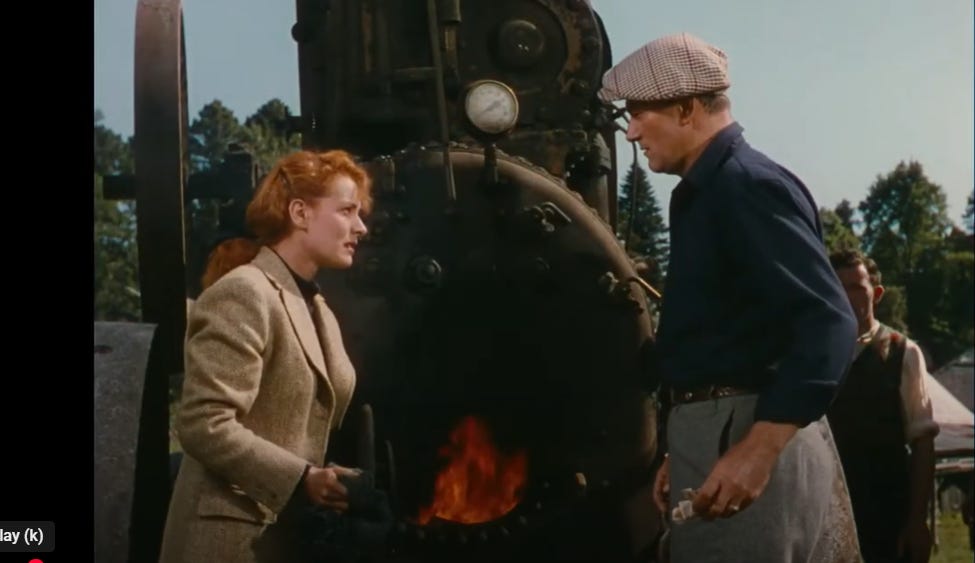
While researching another essay recently on the subject of time (available here) I revisited the 1952 film ‘The Quiet Man’ which I had for a long time dismissed as a silly piece of Paddywhackery full of cliches about Irish life seen through the lens of American sentimentality. But there was one scene in the film which I had always found perplexing: the one in which Maureen O’Hara opening the boiler door silently invites John Wayne to throw her entire dowry of £350 into the fire - which he does, the money goes up in smoke.
The plot of the film for those unfamiliar with it is that a returning Irish American to a rural Irish village falls in love with a local girl and marries her. This marriage had been facilitated by the local community who had duped her older brother into believing that if he allowed his sister to marry John Wayne’s character this meant that he could also marry a rich local widow who had been resisting his proposals up to then. On finding out that he had been deceived, the widow won’t marry him after all, her brother then keeps her furniture and dowry. Under pressure from the local community she gets her furniture back, but her brother still refuses to pay the dowry to her husband. She is upset and refuses to consummate the marriage.
Her husband is exasperated, he doesn’t want the money, but she is insistent. No money, no sex (she does relent but that’s not the point). She runs away, he follows her and drags her back - and publicly issues an ultimatum to her brother: the dowry or else the marriage is cancelled. Her brother gives in and throws the money at him; she then invites him to throw it into a boiler fire in front of the whole community - which he silently does. She is happy and makes it clear that she is now his wife in the fullest sense of the word. There’s a big fight between her brother and her husband which the husband wins. Everyone is friends. The End. Roll the credits.
It’s a baffling story. Who are we supposed to root for? Is Mary Kate greedy, and if so why does she invite her husband to burn her dowry? Why does her brother use her dowry as a way of punishing his rival when he must know that he is humiliating his sister? What’s with the violence? Why did John Wayne need to beat up his brother-in-law to get into bed with his sister? And why does he throw the money that he gets from his brother-in-law into a fire (and to be clear, it isn’t a small amount, it’s £350, the present day equivalent of £22,000 consigned to the flames: it’s still the most shocking thing in the film).
Let me unpick this a little. Mary Kate (O’Hara’s character) is the spinster sister of her much older bullying brother Will ‘Red’ Danaher - living in his house and working for him for nothing for some years on the understanding that he will take care of her for the rest of her life. But she is under his control and must do what he wants. Their parents are dead, and she has few, if any, other options. She is in the gift economy not by choice, but by necessity. Her brother is a boastful bully and unpopular with his neighbours.
But then the arrival of Seán Thornton (Wayne’s character) changes everything. She can escape her brother’s domination and have a house of her own. Her new husband has money and she can live a comfortable life and perhaps raise a family of her own. Her new husband respects her (although there are some disturbing hints of domestic violence scattered in).
But there is a problem in Mary Kate’s mind. What she is bringing to the marriage is her romantic and sexual capital, she is an attractive woman with the possibility of having children. That is all her new husband wants, that and her ability to make a comfortable home for him, something she goes out of her way to demonstrate to him in the opening scenes. And they love each other - it isn’t just transactional.
So what’s with the whole ‘I won’t have sex with you unless you get me my dowry’ business? Seán Thornton is baffled by this, as are we. Why is she using sex as a lever to manipulate him (and why does she sleep with him anyway?). Is she the grasping selfish money grabbing woman that he accuses her of being? ‘Money, I’m sick of the talk of it, is that all you Danahers think about?’ And if that’s true why isn’t she bothered when he throws the whole lot in the boiler?
The village priest apparently does know the answer ‘it’s a custom, and it’s a good one’. But why is it a good one? Her new husband doesn’t care, so why should she? Mary Kate doesn’t explain, but she does make it clear it isn’t because she doesn’t fancy her husband, she does sleep with him, but runs away the day after because she doesn’t think she can be a proper wife to him without her dowry. What’s going on here?
One interpretation is that the dowry is what Hitchcock referred to as a MacGuffin, that it is a device unimportant in itself but is required to propel the plot forward (for example the piece of microfiche concealed inside the statute in his film ‘North by NorthWest’). In this view the dowry itself is not important - but it’s needed for storyline to give the motivation to the main characters. That’s one take on it.
But here’s mine. We think of the principal characters in ‘The Quiet Man’ as the two main protagonists, Mary Kate and Seán Thornton. But I think there is a third: the community of Inisfree. Thornton is not part of this community (he left Inisfree as a child) and he doesn’t understand its ways, he comes from Pittsburgh a place governed by money where if you wanted something you bought it. He has earned his money by his fists prize fighting. In his world you want something, you buy it, no negotiations necessary or taking other people’s feelings into account. It’s a cash only economy.
Inisfree on the other hand is a traditional community deeply steeped in the gift economy. Mary Kate is a younger sibling, with her parents dead and no job, she is forced to rely on the goodwill of her older brother ‘Red’ Danaher for her bed and board and for her social standing. In exchange she manages his house and helps out on the farm; she also gives him social kudos: a house with a woman in it is socially valuable. She is forced to participate in a gift economy but her reward is her security and social standing. Her older brother however is careless of his social standing, at the start of the film he appears as a boastful antagonistic character who upsets his neighbours. This is why the woman he is pursuing as a wife, the Widow Tillane, rejects him.
But the arrival of Seán Thornton changes the whole dynamic because it means that Mary Kate’s future has changed, she has an alternative happier one. But her brother’s refusal to pay the required dowry means that all the work she had done in the past was for her bed and board only, she is walking away from her brother’s house with nothing else. So the ‘gift’ of her time and effort has not been reciprocated in the way that she expected, and she’s not happy: ‘I’m no better than a servant’. Her brother ‘Red’ Danaher too has reason to be unhappy; he suspects that behind the community conspiracy to marry Mary Kate off to Seán Thornton might be a collective desire part to teach him a lesson in humility - taking away his sister and thus lowering his social standing without giving him the promised-for replacement that he expected in the Widow Tillane. But this is not Mary Kate’s fault - the community of Inisfree did this.
The community do try and intervene on Mary Kate’s behalf to get what is unequivocally hers - her furniture - but they cannot force her brother to pay her dowry. And she is deeply unhappy, because in her eyes her social capital was expended for many years (it’s hinted she may be in her mid thirties) on maintaining her brother’s prestige in the community, giving him a comfortable home, and it has all been for nothing because there is no evidence of it. Her new husband doesn’t understand that she wants this to be acknowledged, that her status as a newly married woman in the community depends not just on her sexual capital but on her bringing her social capital along with her in the form of her dowry. The money itself isn’t the point, it’s the reputation that clings to it.
That’s why she doesn’t care if it’s burnt - there is no dialogue when it’s thrown into the fire in front of the whole delighted agog village who are thoroughly enjoying the drama. She is the one who opens the door of the boiler and invites him to throw it in. But this outrageous and seemingly inexplicable action if anything raises her prestige in the village because now not only is she a woman worth every penny of the £22,000 that her new husband has received with her, he has effectively told the whole village that she’s worth far more than that to him because he’s just burnt it all. And she’s just silently told him that he matters more to her than the money because she invited him to do so. Their joint reputation in the community soars: this is a story that will do the rounds for many years to come.
Seán Thornton has learnt a valuable lesson - Inisfree is a place where not everyone has a price, ironically, although he accuses her of being greedy, he cannot see that his new wife’s standing within the community transcends money - no matter how rich he is, he cannot buy it for her. She has had what she wanted: a public acknowledgement of her worth both to her brother, the community and to her new husband.
Her brother ‘Red’ too has also learnt that upsetting his neighbours was a bad idea, his pride has been dented, and his only redress is to accept his defeat with good grace and become friends with his sister and new brother-in-law. As a reward and because he’s shown remorse for his previous unsocial behaviour, he is allowed to court the Widow Tillane who had refused him previously. Viewed this way the dramatic arc of the film is that the unsatisfactory and selfish behaviour of Will Danaher towards his community is ultimately resolved through the inciting incident of Seán Thornton’s arrival and subseqent marriage to his sister via the crisis of the refusal of the dowry and his retraction of his refusal.
The money is burned afterwards because it’s done it’s job and is no longer needed, so it can go up in smoke (so it is actually a sort of MacGuffin). But for a short period the money became the vehicle through which the characters communicated their desires and anxieties to each other: words had failed to do this. It is only the moment when Mary Kate and Seán wordlessly look at each other after the boiler door shuts on the burning cash that they truly understand each other.
Earlier in the film the only person who seems to understand Mary Kate’s point of view about the importance of her dowry was the village priest; the expert on communal beliefs. He knows that marriage is not just about two individuals, it’s about the community that surrounds them (without whose intervention it wouldn’t have happened). The reputation that Mary Kate is so keen on is real and outlasts the money that’s been burnt, because it depends on the people around it, just as if Goldfinger did his worse today in Fort Knox, the world economy would still keep going because money now depends on all of us and what we believe.
Chapter 4. Put-Your-Purse-Away9
The gift economy portrayed in ‘The Quiet Man’ and still present in the 1970s Irish bank strike has now largely disappeared. In most modern Irish households both parents go out to work which means that childcare is carried out, if grandparents are not available, by paid professionals. Likewise care of the elderly is also done by professionals, and more and more of Irish life has been drawn into the net of being monetised. It is easy to be romantic about this; much of this work was what the philosopher Ivan Illich called ‘shadow work’ - necessary work which underpinned the ‘real’ economy but was frequently devalued in the past as unimportant and usually carried out by women.
But there was a huge advantage to this unpaid labour: it could not be taxed and quantified and took place away from the scrutiny of the state. When women started entering the workforce in Ireland in large numbers in the 1980s this work - which still needed to be done - usually fell to other women - most low paid, but taxed. Thus the state got a huge increase in income and a massive expansion into areas of life previously outside its purview. The bribe for persuading higher status women that outsourcing the care of their children to others was the huge increase in consumer goods and lifestyles that it enabled (again, handing the state even more tax revenue). But this often came at hidden expense, the substitute care was not always as good as being cared for by those who loved you and the vast expansion of consumerism has had high costs in pollution and status anxieties. Thus there is much to ponder on Professor’s Bendell suggestion that society should consider going back to some form of the gift economy and money should be taken out of certain areas of human life.
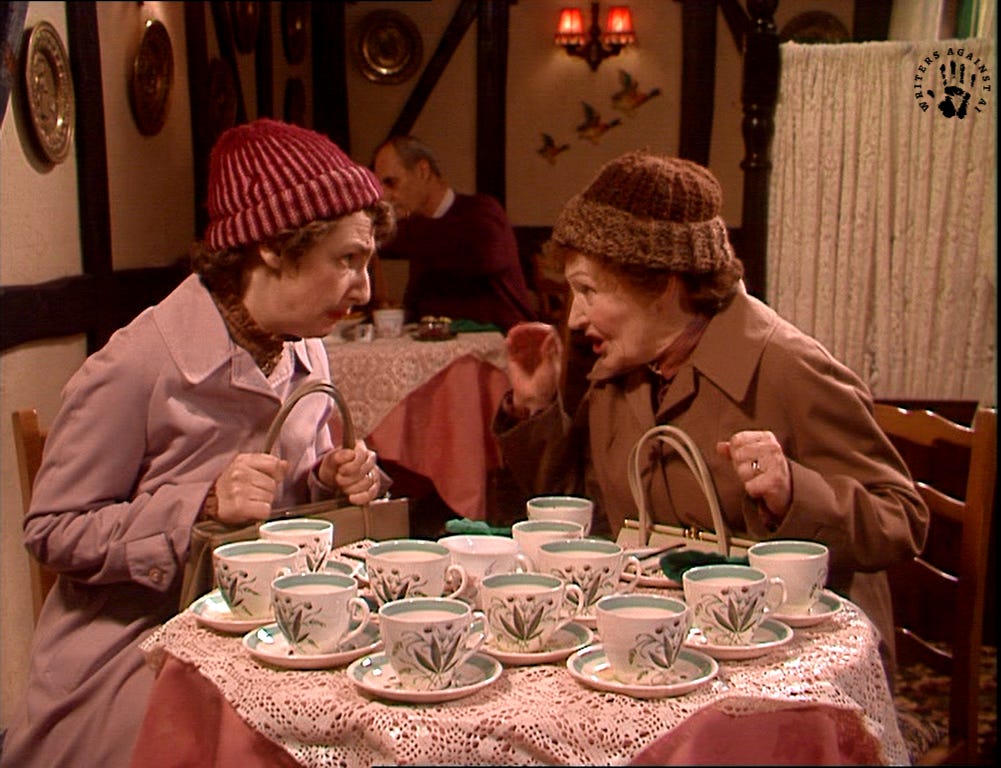
But what role does that leave for it? Now, if you are still with me and wondering where on earth all this is leading to, I’d like to tell you a little story if I might from the 1990s TV comedy drama ‘Father Ted’ about the adventures of a household of Irish Catholic priests in rural Ireland. One episode in the 1998 third series called ‘The Mainland’ brought back some poignant memories for me. In it the priest’s housekeeper Mrs Doyle takes her friend Mrs Dineen out for tea. At the end of the meal the two women fight over who’s going to pay, both insisting that they will. The fight intensifies with both women eventually ending up being arrested and in a prison cell.
This scene made me laugh because this was only a slight exaggeration of the many, many times I had witnessed my mother and my aunt practically coming to blows over who would pay for a meal to the eye rolling exasperation of everyone around them; I called it the Put-Your-Purse-Away drama. As a teenager I found it baffling, why could they never remember who paid last, and what did it matter so much to them?
But looking back on it I think what they were really doing was negotiating a relationship, who would feel indebted to whom and how comfortable the other party was about it. Too much generosity could be as fatal as too little. The woman who never paid risked earning the dreaded name of being ‘mean’ equally the one who always insisted on paying would soon realise that others viewed her generosity, not as kindness but an unwanted imposition. Previous interactions counted, if you paid the last time then of course it was your turn to pay this time, but you had to let your opponent try, because not to do so would imply that she might not be able to afford it, so to save dignity she had to make an attempt. But you both knew from the start who would ultimately pay. This didn’t stop a whole performance of Put-Your-Purse-Away (sneaky tactics of waiting until someone went to the loo and paying the bill behind their back sometimes happened). It was all so complicated and entertaining for watching bystanders (unless you were the poor waiter who had to stand there waiting for someone to decide who was going to give in first).
The Chinese have now designed a system of social credits, where instead of money people earn social credits which can be offset against opportunities for jobs or housing. In China there would be no need for my mother and aunt to argue, they could just whip out a smartphone app which could show who had paid for the meal the last time so eliminating all the convoluted discussions - Mrs Doyle and Mrs Dineen would avoid jail. But is that really the answer? To take away money and replace it with a gift economy where you can keep track with apps of who owes what to whom. This would give you all the advantages of the gift economy without the messy emotional residue, right?
My mother and my aunt of course would never use an app to decide whose turn it was, not just because neither would ever consider using that sort of technology, but also because very sadly my beloved aunt died young many years ago. My mother and aunt loved each other dearly, but I never heard them use those words to each other - their generation rarely did. Or at least, I didn’t think I did, until I remembered all those Put-Away-Your-Purse fights; now I understand that was a coded way of each woman telling the other how much they valued each other, how important the other’s opinion was to them, in short how much they loved each other. And the way they did this was through the medium of money.
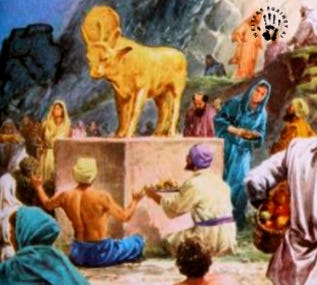
So much as I respect the opinion of Professor Bendell (and agree with many of his main points) I don’t think the answer to our problems is a full return to a gift economy, our core problems in my view are not actually about money, or oil or indeed physical stuff at all, our problems are about human consciousness and the ways we try to change it. I think the main problem with money is that we forget that it is a method of communication, not an end in itself. We have turned it instead into an idol: a lesson as old as the Biblical story of the Israelites and the Golden Calf.
There is certainly serious consideration I think to be given to demonetise various sections of our lives - to consider whether money really should extend its tentacles into every aspect of human life (and abolishing compound interest would be a huge improvement along with its bastard offspring - endless economic ‘growth’). The gift economy could certainly be expanded fruitfully in my view so that the State could retreat to being a framework for human and planetary flourishing - not continue its ruthless march into every aspect of human life (and I’m fully aware that the chances of any of this happening anytime soon are vanishingly tiny).
But if, in a thought experiment, we did radically expand the gift economy I’m really not sure that replacing money with another abstraction like social credits is not going end with us getting into exactly the same mess that we are now. In my view the root of our problems is the illusion that we can quantify everything - that a frictionless life is possible, that the messy business of human life can be sanded down to a smooth world where you just wave away all difficulties through an app. Perhaps the elimination of discomfort, mild irritation or of pain robs us of the opportunities to grow as human beings?
Maybe we might need to let middle aged women fight over tea shop bills, to have men and women wield money as a way to come to their own messy compromises about life and love through trial and error - or not - as the case may be. If money is a just a construct of human consciousness, then perhaps its most important role to facilitate shifts in this consciousness, just as in the moment when Mary Kate and Seán lock eyes over the burning cash and, in a telling metaphor drawn from money itself, ‘the penny drops’ for both of them that they love each other and that their marriage will be a success. So even in a largely gift economy we could still keep money as a way for people to negotiate understanding with each other, for a community to enable the things they value. But also, once its job is done that we could, like Mary Kate and Seán, throw the money into the fire and carry on living.
We never do find out what Michael Caine’s great idea for rebalancing the bus between the gang and the gold is and whether it goes over the cliff…..
If you have enjoyed this essay (and you want me to continue writing) then:
Press the Like button
Restack on your own Substack (if you have one)
Comment (I love feedback)
Share with people you think might enjoy it.
Jem Bendell et al, 2023, ‘Breaking Together: A Freedom Loving response to Collapse’, Good Works .
https://en.wikipedia.org/wiki/K_Foundation_Burn_a_Million_Quid
https://jembendell.com/
Excellent piece! And very accurate😂
Holy Moly, Brid. What a fine piece of writing in every way!
Brilliant and thoughtful, educational and humorous. I know a lot of people who would benefit from your perspective and observations.
Thank you!
And the Chinese system? It also punishes for breaking the rules, taking away credits essential for buying a train ticket, renting a home, etc. Perhaps, still similar to the effects of the disdain created by the local community model, but in this case, dictated by the whims of the Party. 😊